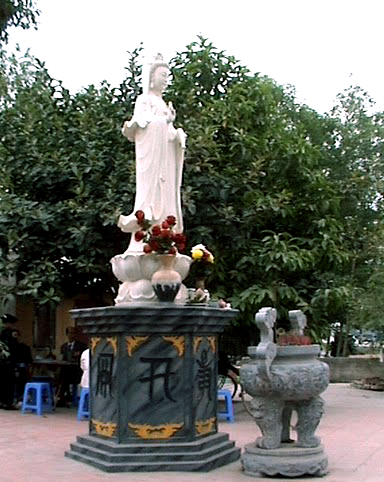
Xuân Quan Pagoda
Bắc Ninh(Chùa Xuân Quan)
Overview & history
Xuân Quan Pagoda (its formal name is Huệ Trạch Tự) also known as Dàn Xuân Quan Pagoda, is a pagoda located within the Tứ Pháp pagoda complex, but was built later, reportedly around the 13th century. The pagoda is situated in Trí Quả ward, Bắc Ninh province.
Name
The formal name of the pagoda is Huệ Trạch Tự (Chinese characters: 惠澤寺), with 'huệ trạch' meaning 'grace permeates' ('huệ' means favour, 'trạch' means a pond or marsh). This name may also be related to the nearby village Đại Trạch (Chinese characters: 大澤), associated with the legend that the village's tutelary deity Trần Hồng Hưng had Xuân Quan Pagoda built, and that both Xuân Quan and Đại Trạch villages worship Pháp Thông Vương Phật.
The pagoda is also called Dàn Pagoda, a shortened form of Dàn Chợ Pagoda, after the vernacular name of Xuân Quan village (Dàn Chợ village). However, about 800m from the pagoda, also in Trí Quả commune, there is another pagoda in Phương Quan hamlet (Dàn Câu village) also called Dàn Pagoda, so this pagoda is referred to as Dàn Xuân Quan Pagoda or Xuân Quan Village Pagoda for distinction.
On the "Xá Lợi Tháp Minh" stele, which bears the oldest Chinese inscription found in Vietnam and was unearthed in 2004 near Xuân Quan Pagoda, it is also revealed that the ancient name of the pagoda was Thiền Chúng Tự.
History
Researchers classify the pagoda as part of the Tứ Pháp pagoda complex in the Dâu - Bắc Ninh region; however, the construction date of the pagoda is determined to be much later than the other four pagodas, reportedly around the 13th century.
A stone stele at Đại Trạch Pagoda (Đại Trạch hamlet, Đình Tổ commune) titled Đại Thánh Pháp Thông Phật phả lục, compiled by Nguyễn Bính of the Hàn Lâm Viện Đông các during the Lê Trung Hưng period, records the legend of Đại Thánh Pháp Thông Phật and Trần Hưng Hồng, the son of Trần Hưng Đạo's second wife, who had Xuân Quan Pagoda built to give thanks to Phật Pháp Thông for aiding in the fight against the Yuan invaders, as follows:
King Trần Thánh Tông ordered Hưng Đạo Đại Vương Trần Quốc Tuấn to act as supreme commander of the army to fight the enemy. Hưng Đạo Vương sent his son, Trần Hưng Hồng Vương, to lead troops towards Kinh Bắc. Passing by Xuân Quan Pagoda, the prince entered to make offerings, praying for support in fighting the Yuan invaders.
After the ceremony, as evening fell, the prince stationed his troops there. At midnight, the pagoda was filled with radiant light and fragrant incense. He saw a celestial maiden descend from the sky, dressed in yellow, who entered and sat before the main hall, saying: 'I am Đại Thánh Pháp Thông Vương Phật. The Jade Emperor has tasked me with overseeing the Four Dharma Guardians, the Deity of Wind and Rain, and as the ruler of this locality. Seeing the country invaded by the Yuan, and the king sending troops to fight, I vow to help so that my spiritual efficacy may be seen.' Having spoken, she vanished. Trần Hưng Hồng immediately made offerings in gratitude and promptly led his troops to battle. Upon reaching the enemy, before fighting, the enemy forces scattered on their own, and he, along with all the famous generals, slew Ô Mã Nhi. From then on, the Yuan dared not invade again.
Returning victorious, he wrote a memorial to the king recounting the spiritual efficacy at Xuân Quan Pagoda in helping to defeat the enemy. The Trần king then issued an edict, as per the report, conferring the title Đại Thánh Pháp Thông Vương Phật Linh Ứng. He ordered officials to bring the edict to offer sacrifices, and granted money to the people to repair the Buddha statue for worship.
Afterwards, the pagoda was very efficacious, especially in prayers for wind and rain, which were always answered. Therefore, it was granted perpetual incense offerings, to be maintained for all generations, and Phương Lan commune, Xuân Lan hamlet, and Đại Trạch commune were assigned to serve the pagoda.
The Tạ Ân Festival and the rituals for worshipping Trần Hồng Hưng and his mother, Lady Quế Hoa Nương, are still maintained in Đại Trạch village and Ư Trì village (Đình Tổ commune) near Xuân Quan village.
Xuân Quan Pagoda is essentially a complex of đình (communal house) – đền (temple) – chùa (pagoda) within a single architectural ensemble. There are three main worship axes, arranged along three longitudinal axes of the site:
The central axis is dedicated to Phật chủ Pháp Thông (Temple)
The left axis (looking from inside out) is for Buddha worship similar to the Tam Bảo hall in other pagodas (Pagoda)
The right axis is for worshipping the village's tutelary deity (Linh Nại Đại Vương, a figure from the Hùng Kings era) (Đình)
The pagoda still preserves its oldest artefact, a four-sided stele placed in front of the pagoda, made in the 20th year of Chính Hòa (1699), which records the construction of the bell tower and the casting of a large bell at that time. Today, both the bell tower and the bell are gone. At the site of the former bell tower, only five large stone bases remain (0.70m x 0.70m). Thus, it can be initially determined that at least by the late 17th century, Xuân Quan Pagoda was already a major pagoda in the region.
Pháp Thông Vương Buddha
Pháp Thông Vương Buddha is the principal deity worshipped at Xuân Quan Pagoda. The stone stele 'Đại Thánh Pháp Thông Phật phả lục' records the legend of Pháp Thông Buddha from the reign of Lý Thần Tông as follows:
(...) Lý dynasty (...) passed from father to son. From Thái Tông, Thánh Tông, Anh Tông, to Thần Tông.
In the Kinh Bắc region, Thuận An prefecture, Siêu Loại district, Phương Lan commune, Xuân Lan hamlet. There was a Nguyễn family, a man named Ông Thành, who married a woman from the same district, Đại Trạch commune, named Nguyễn Thị Nga. The couple were harmonious and well-matched, but childless for over 20 years.
The couple went to Sơn Lam Thượng, Ứng Thiên Prefecture, Hoài An district, Hương Tích cave. Truly the most beautiful scenic spot in Thiên Nam, very sacred, where prayers are answered. (...) After making offerings to Buddha, that midnight, they dreamt of passing through a row of houses and splendid palaces. A man in a blue robe, holding a ceremonial branch, led them into a level where they saw a radiant palace, with many officials in attendance. (...) While Ông Thành and his wife, startled and fearful, knelt before the altar, they saw on the upper level an official wearing a hundred-starred hat and a yellow robe, sitting very solemnly. He spoke loudly, saying that the couple's sincere good deeds had reached the heavens. Heaven would send a celestial maiden named Giáng Kiều to be reborn as their child. Knowing this was a good omen, the next morning the couple made offerings of thanks before Buddha. A few months after returning home, the wife became pregnant; after 12 months, on the 12th day of the 4th lunar month, she gave birth to a beautiful daughter, with rosy lips, powdered cheeks, phoenix eyes and arched brows, truly incomparable. The couple were overjoyed and deeply loved her. Remembering the dream, they did not dare give her a common name, but called her 'First Lady' (Đệ nhất Nương Tử).
At age 12, both her parents died, and Nương Tử lived with her aunt in Đại Trạch commune.
At age 14, her aunt wanted to arrange a marriage, but Nương Tử refused and from then on grew her hair, became a nun, and followed Buddhist precepts. One day, hearing that at Phật Tích Pagoda there was a Zen master named Từ Đạo Hạnh, a highly virtuous monk, Nương Tử asked to study with him. Nương Tử already knew all the Buddhist scriptures, so after only a few months, she mastered many extraordinary skills: summoning wind and rain, performing miracles, thunder and lightning, transformation and invisibility, coming and going unnoticed. Truly a transcendent Nương Tử. The master and monks greatly loved and respected her, so she named herself Pháp Thông.
Having attained enlightenment, Nương Tử returned to Xuân Lan hamlet, built a pagoda at the entrance of the village to practise day and night, keeping precepts and chanting sutras. In Xuân Lan and Đại Trạch, both inner and outer hamlets, the poor were helped, the sick were healed, so the people of both hamlets remembered her merits, cherished her like the sun and moon, and loved her as parents.
That year, on the 15th day of the 8th lunar month, Nương Tử bathed, changed clothes, set up an incense altar in the courtyard, burned incense, prayed and chanted sutras. On that clear autumn night, suddenly a black cloud descended overhead. The sky turned dark, wind and rain roared, thunder rumbled, and Nương Tử vanished. She was 18 years old. After her transformation, only her old clothes remained. The people, knowing what had happened, were moved by her virtue, so they buried her clothes in the pagoda and created a sacred statue. They inscribed the title 'Pháp Thông Buddha' and made the pagoda a temple for worship.
At that time, Đại Trạch commune, learning of her transformation and remembering her merits, also established a worship site at their pagoda. Every year, on the Buddha's birthday in the 4th lunar month, people from Phương Lan commune, Xuân Lan hamlet, would bring the Buddha back to their place for worship; thus, both hamlets have served her annually as a tradition.
The pagoda still preserves the imperial decree conferring the title 'Đại Thánh Pháp Thông Vương Buddha' from the 9th year of Khải Định (1924), granted by King Khải Định on the occasion of his 40th birthday celebration:
Translation:
Decree for Xuân Quan hamlet, Phương Quan commune, Siêu Loại district, Thuận Thành prefecture, to respectfully worship Đại Thánh Pháp Thông Vương Buddha, the revered deity who protects the nation and shelters the people, with many years of efficacious response. Now, on the occasion of my 40th birthday celebration, I bestow this precious decree in deep gratitude, according to custom, with increased rank; the first act is to grant this favour everywhere, recognising merit and conferring the title 'Túy mục dực bảo trung hưng thượng đẳng thần'. The villagers are to respectfully worship. The deity is to strive to protect and aid the people.
Respect this order.
25th day of the 7th month, 9th year of Khải Định
The village chronicle of Xuân Quan also records Pháp Thông Vương Buddha as 'Chief of the Four Dharmas' (Trưởng Tứ Pháp), head of the four deities of the Tứ Pháp, and 'ruler of this locality'.
On the altar, the statue of Pháp Thông Buddha is placed in a large domed shrine. The statue is 1.10m high, seated on a four-tiered lotus pedestal 0.245m high. Pháp Thông is depicted sitting cross-legged, right hand extended forward, left palm up on the thigh, with a gem set in each palm. When the statue is undressed (removing the headdress and robe), the entire statue is seen to be painted in a dark brown colour. The head clearly shows curly hair in the 'snail-shell' style of the Buddha, but the body is that of a beautiful woman, with a long neck and two small breasts. Even when 'undressed', from the waist down the statue remains covered, as a skirt is carved as part of the statue, with a sash tied at the waist—this costume closely resembles the statues of the Four Dharmas at Dâu Pagoda, Tướng Pagoda, and Dàn Pagoda. Thus, it can be surmised that the statue was carved around the 17th century.
Linh Nại Đại Vương
Linh Nại Đại Vương is the tutelary deity (thành hoàng) of Xuân Quan village, worshipped on the right side (as seen from inside looking out) in Xuân Quan Pagoda. The pagoda still preserves the imperial decree conferring the title of 'Middle-ranked Deity' (Trung đẳng thần) from the same 9th year of Khải Định (1924):
Translation:
Decree for Xuân Quan hamlet, Phương Quan commune, Siêu Loại district, Thuận Thành prefecture, as previously worshipped and conferred the title 'Diệu cảm mặc phù chương hiển đôn nghi dực bảo trung hưng thành hoàng linh ứng tôn thần', protector of the nation and shelterer of the people, with many efficacious responses, and previously granted a decree for worship. Now, on the occasion of my 40th birthday celebration, I bestow this precious decree in deep gratitude, according to custom, with increased rank; the first act is to grant this favour everywhere, now conferring the honorary title 'Tĩnh hậu trung đẳng thần'. The villagers are to respectfully worship, to commemorate the nation's joyous occasion as reflected in the ceremony.
Respect this order.
25th day of the 7th month, 9th year of Khải Định
Architecture
The pagoda currently retains three main buildings: the front hall (tiền đường), incense hall (thiêu hương), and upper hall (thượng điện). The upper hall is separated from the front architectural block by a small drainage channel, so both the roof and foundation of the upper hall are actually constructed independently from the front block.
The front hall: consists of five bays and two wings, the largest in scale, measuring 19.6m in length and 7.95m in width. The building has four roofs, surrounded by walls, with four sharply curved dragon-tail corners. On the roof ridge are sculpted two dragons flanking a moon, and in the centre are three large Chinese characters: 'Huệ tự Trạch'. The ironwood (lim) frame remains quite solid, constructed in the 'chồng rường - giá chiêng' style, with seven beams at the front and seven at the back. In the two central bays, the upper frame above the main beam and side beams does not use the 'con chồng' structure, but is replaced by decorative panels for ornamentation.
The incense hall: consists of three bays, connected to the front hall by two corridor bays (ống muống). Its wooden frame is also built in the 'chồng rường - giá chiêng' style, but on a smaller scale than the front hall.
The upper hall: consists of three bays, located behind the incense hall. This building has a beautiful architectural style, in the form of an eight-roofed, two-storey house (nhà chồng diêm 8 mái)—the eight corners of the roof are eight gracefully curved dragon tails, making the whole structure resemble a large lotus, with the petals as the dragon tails stretching skyward, offering to the Buddha realm. The wooden frame here is built in the 'kẻ truyền' style, simple but quite sturdy.
In addition to the Pháp Thông statue and the two imperial decrees, the pagoda also has a rich system of worship statues and many ritual objects and notable relics: 30 Buddha statues, a statue of Đức Thánh Tải (dating to the mid-19th century), a wooden throne from the Lê dynasty, two stone steles dated 1679 and 1876, the Huệ Trạch Pagoda bronze bell cast in 1826, and many other ritual objects in wood, stone, and metal.
With its outstanding historical, cultural, and artistic values, Xuân Quan Pagoda was recognised and classified as a National Historic and Artistic Monument by the Minister of Culture, Information and Sports in 1992.
Photos
📷 Contribute photosVisiting tips
- Dress modestly; remove hats and keep quiet inside the main hall.
- Incense, flowers and offerings are usually sold right outside the gate; light an odd number of sticks (1 or 3).
- Most pagodas open from early morning to evening and are free to enter (some major sites charge a small scenic fee).
- Full-moon days, the 1st of the lunar month and Tet are very crowded; visit on weekday mornings for a quiet experience.
- Ask permission before photographing inside shrines; do not touch statues or altar objects.
Read more & references
Useful links to learn more before your visit:
Location
Coordinates: 21.20931, 106.05521
🧭 Directions on Google MapsReferences
- Vietnamese Wikipedia
- http://vbpl.vn/TW/Pages/vbpq-toanvan.aspx?ItemID=11203
- http://dsvh.gov.vn/Upload/files/5512_Them%20mot%20ngoi%20chua%20vao%20he%20thong%20tu%20phap%20vung%20dau.pdf
- http://thuanthanh.bacninh.gov.vn/news/-/details/22340/chua-xuan-quan-hue-trach-tu-huyen-thoai-va-lich-su
- http://www.hannom.org.vn/detail.asp?param=2362&Catid=476
- http://svhttdl.bacninh.gov.vn/news/-/details/57300/phat-phap-thong-va-le-hoi-ta-on-lang-ai-trach
- http://0912222315.blogspot.com/2014/03/lich-su-di-tich-chua-lang-xuan-quan.html
- https://tools.wmflabs.org/geohack/geohack.php?language=vi&pagename=Ch%C3%B9a_Xu%C3%A2n_Quan¶ms=21.047961_N_106.029373_E_type:landmark
- https://web.archive.org/web/20230428012312/http://www.hannom.org.vn/detail.asp?param=2362&Catid=476
Other pagodas in Bắc Ninh