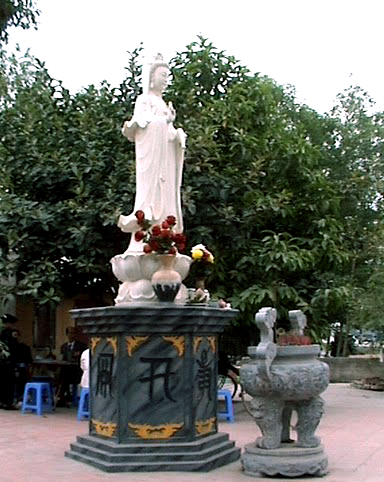
Bổ Đà Pagoda
Bắc Ninh(formerly Bắc Giang)(Chùa Bổ Đà)

Overview & history
Bổ Đà Pagoda, also known as Bổ Pagoda, Tam Giáo Pagoda, and by its formal name Tứ Ân tự (四恩寺), is a pagoda located on the summit of Phượng Hoàng Mountain (Bổ Đà sơn), on the left bank of the Cầu River, within the Thượng Lát residential group, Vân Hà ward, Bắc Ninh province (in feudal times: Tiên Lát village, Tiên Lát canton, Yên Việt district, Bắc Hà prefecture, ancient Kinh Bắc region). The pagoda is about 10 km west of the centre of Bích Động town. Bổ Đà Pagoda is one of the most unique pagodas in the Kinh Bắc region and is a major Buddhist centre of the Trúc Lâm Yên Tử Zen sect. The pagoda was recognised as a Special National Monument in 2016, and the collection of Buddhist scriptures carved on thị wood preserved in the pagoda is considered the oldest of the Lâm Tế Zen lineage.
Bổ Pagoda is one of the few places that still retains the original features of ancient Vietnamese traditional architecture. The pagoda has a unique and distinctive architecture compared to traditional pagodas in Northern Vietnam, with the most beautiful and largest stupa garden in Vietnam, many valuable antiques, and a rich Han-Nom heritage. This is also a place where mountains and water harmonise, with the pagoda facing the river and leaning against the mountain, the scenery and atmosphere imbued with legend, surrounded by hills, mountains, and villages. The pagoda worships the Three Teachings (Tam giáo), including Avalokiteśvara Bodhisattva (Quán Thế Âm Bồ Tát), the Trúc Lâm Three Patriarchs (Trần Nhân Tông, Pháp Loa, and Huyền Quang), Confucius, and others. Books made of bamboo and stone that remain are still used to train those joining the Lâm Tế sect (Sơn Môn Bồ Đà) according to old customs. The Bổ Đà Pagoda complex is a group of relics including: the ancient pagoda named Bổ Đà sơn (abbreviated as Bổ Đà Pagoda, Bổ Pagoda; also called Quán Âm Pagoda), the main Tứ Ân Pagoda, and Tam Đức Hermitage (Am Tam Đức, built later, during the Later Lê dynasty). In addition, on Bổ Đà Mountain there is also a temple dedicated to General Thạch (Thạch tướng quân, i.e. Thạch Tướng Đại Vương, who contributed to helping the 16th Hùng King resist foreign invaders).
The current abbot of the pagoda is Venerable Thích Tục Vinh (secular name: Trương Lý Vinh), a member of the Executive Board of the Vietnam Buddhist Sangha (GHPGVN) of Bắc Giang province, term V (2017-2022).
The Legend of the Woodcutter
The legendary story of the origin of Bổ Đà Pagoda is shrouded in mystery. It is said that around the 11th century, at the foot of the mountain lived a woodcutter's family who, though poor, were very kind, diligent, and gentle, beloved by all the villagers. However, despite being over 40 years old, they still had no children. One day, the husband carried his axe and hatchet up the mountain to gather firewood and came across an old pine tree. With each chop, he recited: "Quan Thế Âm Buddha". Afterwards, he found 32 coins at the base of the tree. Surprised, he went to consult a high monk, who told him: "The Bodhisattva Avalokiteśvara (Quan Âm) has 32 manifestations." The woodcutter prayed: "If the Bodhisattva Avalokiteśvara blesses me with a son, I vow to build a pagoda in her honour." Indeed, the woodcutter later had a son, and after saving some money, he built a pagoda right at the old pine tree, thatched the roof, and sculpted a statue of Quan Âm Tống Tử (Avalokiteśvara bestowing children) for worship. Gradually, more and more people came to worship, and whatever they prayed for would come true, so the site became a famous scenic spot, hence the name Ông Bổ Pagoda (Pagoda of the Woodcutter). Because it was a pagoda worshipping the Buddha (Bụt Đà, derived from the word Buddha) who had manifested to help the woodcutter (ông bổ củi), it became known as Bổ Đà Pagoda. There is also another explanation that Bổ Đà is a corrupted pronunciation of Phổ Đà, which itself derives from Buddha. This is the place where Avalokiteśvara Bodhisattva manifested to save the world, so it is also called Quán Âm Pagoda. Later, as the pagoda complex came to include Tứ Ân Pagoda, it was also called Tứ Ân tự (the name of the main pagoda used for the whole complex, including Tứ Ân Pagoda, Quán Âm Pagoda, Cao Pagoda, etc.).
History
The book Bắc Ninh Toàn Tỉnh Địa Dư Chí records: Bổ Đà Mountain is the foremost mountain of Việt Yên district. It begins from Thái Nguyên, passes through Yên Thế, and continues. Many peaks cluster together, with Bổ Đà Mountain suddenly rising, both high and large. Among them, the highest peak is called Phượng Hoàng Mountain. The slightly lower peaks are Yên Ngự Mountain and Kim Quy Mountain. The mountain has Tam Giáo Pagoda and a miếu (shrine) to General Thạch.
Material traces and documents remaining at the pagoda indicate that it dates from the Lý dynasty in the 11th century and was rebuilt during the Lê Trung Hưng period, under the reign of King Lê Dụ Tông (1705-1728).
During the Việt–Song war of 1077, Song troops camped in the hills and forests of Tiên Lát around the Bổ Pagoda area. After a failed attack at Như Nguyệt, Quách Quỳ decided to launch a second attack at Tam Đa village because the Cầu River there was shallow and narrow, making it easier to cross towards Thăng Long. Lý Thường Kiệt had anticipated this, so he built high defensive lines, planted thick bamboo fences, set up cavalry camps, and stationed troops in dense areas. The Song army took advantage of the night, secretly moving from the Tiên Lát mountain basin to the riverbank, lashing trees together to make large rafts, each carrying 500 soldiers, then suddenly launching many rafts, rapidly ferrying troops into Thọ Đức – Phấn Động, risking everything to break through. At that moment, Lý's troops simultaneously charged from the high banks. The Song army was in dire straits and could not retreat. The entire Song force that crossed the river was destroyed, most were killed, and the rest surrendered. After this defeat, Quách Quỳ lost all capacity to attack and ordered that anyone who suggested further attacks would be executed.
In the year Quý Mão (1723), Bảo Thái era of the Lê dynasty (1720–1729), the abbot was Phạm Kim Hưng, an official in charge of the royal archives. Discontented with the court, he resigned and returned to his homeland. At that time, the court allowed people to follow the three main teachings: Buddhism, Confucianism, and Daoism. In the Lê royal court, there was a weekly lecture on the Three Teachings. Like Bút Tháp Pagoda, Bổ Đà was reserved for royalty to practise. After resigning, with his lectures on the teachings, Phạm Kim Hưng also shaved his head and entered Bổ Pagoda, devoting himself to Buddhism. He restored the main hall, incense hall, front hall, erected stone and wooden pillars, and added several rooms, but the inscriptions on the stone steles have faded, leaving no trace of the ancients.
During the Cảnh Hưng era of the Lê dynasty (King Lê Hiển Tông 1740–1786), a patriarch surnamed Ngô (Ngô Tính Ánh, Ngô Tuệ Không) from Bình Vọng village, Thượng Phúc district, Hà Nội province (now Thường Tín district, Hà Nội city) came. He renounced wealth and luxury, became a monk, was given the title Hảo Tiết Hòa Thượng, dharma name Tinh Anh, and travelled here. Seeing the spiritual and tranquil landscape, he decided it could be a great place for teaching, so together with the people, he built Tứ Ân Pagoda and Tam Đức Hermitage (at that time the hermitage had only three patriarchs' stupas). He also restored Quán Âm Pagoda, using ironwood and tiles to build a hall, and appointed monks from Tứ Ân Pagoda as abbots. From then on, it became a bustling monastic centre. In the fourth generation, Abbot Chiếu Không restored a two-room stone building in the year Giáp Ngọ (1834), Minh Mạng era (1820–1840). In the Thiệu Trị era (1841–1847), a statue of Avalokiteśvara was cast, and Tứ Ân Pagoda was newly built. In the Tự Đức era (1847–1883), his disciple Phả Thuần built a five-room front hall for chanting. At this point, the entire Bổ Pagoda complex was completed with up to 100 rooms.
From 1786 onwards, many successive abbots built up Bổ Pagoda, including Abbots Như Chiếu, Phả Tiến, and others, who repeatedly restored and expanded the pagoda into a large monastic centre. According to Venerable Thích Tục Vinh, the current abbot, not only did Phạm Kim Hưng retire here to practise, but there were 18 others, making a total of 19. When serving at court, some followed Buddhism, some Confucianism, some Daoism. Upon coming to the pagoda, all followed Buddhism, but each disciple had to worship their teacher (parents at home, Buddhas in the world), so the pagoda worships the Three Teachings. This is a special feature rarely found in other Vietnamese pagodas.
Through the vicissitudes of history, despite many wars, Bổ Đà Pagoda has fortunately retained its ancient appearance since its founding. During the resistance wars against the French and Americans, Bổ Đà Pagoda also served as a revolutionary base for the Vietnam People's Army; General Võ Nguyên Giáp suggested the pagoda be chosen as a training ground for reconnaissance troops, serving the cause of southern liberation.
On 31 January 1992, Bổ Pagoda was recognised as a National Architectural and Artistic Monument under Decision No. 138/QĐ by the Ministry of Culture, Information and Sports, signed by Deputy Minister Vũ Khắc Liên.
In 2007, the Ministry of Culture and Information invested 17 billion VND to completely restore the entire relic complex.
On 22 December 2016, Bổ Đà Pagoda (together with 12 other relics) was recognised as a Special National Monument (7th batch) under Decision No. 2499/QĐ-TTg by the Prime Minister, signed by Deputy Prime Minister Vũ Đức Đam.
On 12 March 2017 (the 15th day of the 2nd lunar month, Đinh Dậu year), on the occasion of the Bổ Đà Pagoda Spring Festival, the People's Committee of Bắc Giang province solemnly held a ceremony to receive the Certificate of Special National Monument status.
Outstanding Heritage
Bổ Đà Pagoda is one of the major Buddhist centres of the Trúc Lâm Zen sect, and is among the few places that still preserve the original features of ancient Vietnamese traditional architecture. Currently, Bổ Đà Pagoda still retains many documents, artefacts, and precious antiques of great cultural, historical, architectural, and artistic value. Notably, it houses the oldest set of Buddhist woodblock sutras in Vietnam, carved on persimmon wood. Recently, a very interesting relic of the writer Nguyên Hồng was discovered at the pagoda: a handwritten copy of the monastery's regulations from the time when he renounced worldly life to become a monk.
A Major Buddhist Centre of the Trúc Lâm Zen Sect
Bổ Đà Pagoda is one of the major Buddhist centres of the Trúc Lâm Yên Tử Zen sect. The Trúc Lâm Zen sect is the fourth Zen lineage in Vietnam, founded by Điều Ngự Giác Hoàng Trần Nhân Tông (1279–1293). This sect is considered a continuation of the Yên Tử lineage, which itself was a merger of three Vietnamese Zen lineages from the 12th century: Thảo Đường, Vô Ngôn Thông, and Tì-ni-đa-lưu-chi, and represents the independent and creative nature of Vietnamese Buddhism. Điều Ngự Giác Hoàng Trần Nhân Tông is regarded as the first patriarch. The second patriarch is Kim Cương Pháp Loa, and the third is Huyền Quang (collectively known as the Trúc Lâm Tam Tổ, or Three Patriarchs of Trúc Lâm). Statues of all three patriarchs are enshrined in the ancestral hall of the pagoda. Later, in the 18th–19th centuries, the Trúc Lâm Zen sect merged with the Lâm Tế school, and Bổ Đà Pagoda was also considered one of the major Buddhist centres of the Lâm Tế Zen lineage. This is the place where patriarchs established dharma schools and trained monks and nuns. Every year, during the summer retreat (kết hạ an cư), many monks, nuns, and devotees gather here to practise meditation and study the Dharma.
Features of Ancient Vietnamese Traditional Architecture
Bổ Đà Pagoda is one of the few places that still preserves the original features of ancient Vietnamese traditional architecture. The pagoda has a unique and distinctive architectural style compared to other traditional pagodas in northern Vietnam, characterised by the "open inside, closed outside" layout, creating a secluded, tranquil, and sacred atmosphere. The harmonious architectural composition is constructed from materials such as fired bricks, tiles, ceramic fragments, and especially walls made of earth, which are very unique. The walls, gates, and some other structures are built entirely from rammed earth using the chình tường technique. The entrance gate is paved with salt stones of various sizes, built in the Nguyễn dynasty architectural style, resembling a bell tower. A special feature here is that many walls are built with ceramic fragments similar to those in Thổ Hà village, a place specialising in the production of jars, vases, and ceramic wares just a few kilometres away, creating a very contemplative atmosphere reminiscent of rural villages in the Red River Delta. The entire main pagoda covers an area of about 51,784 m², divided into three distinct zones: the garden area (31,000 m²), the inner pagoda area (13,000 m²), and the stupa garden area (7,784 m²).
Ancient Stupa Garden: One of the distinctive features of Bổ Đà Pagoda that visitors should not miss is the stupa garden. The stupa garden is a sloping plot of land on the side of Bổ Đà Mountain, covering nearly 8,000 m², where the relics and ashes of the Lâm Tế Zen patriarchs are kept. The pagoda has used mountain stones, bricks, and clay to build a long wall surrounding the stupa garden, keeping the area always in deep tranquillity.
With about 100 stupas, the stupa garden at Bổ Đà Pagoda is considered the most beautiful and largest among ancient pagodas in Vietnam. This is the resting place of more than 1,000 eminent monks who practised at the pagoda throughout history. Each stupa contains the remains of 4 to 26 individuals; most stupas in the garden are 3–4 storeys high, with a height of 3–5 metres, while the patriarchs’ stupas are even larger and taller.
The stupas are arranged in rows and built according to strict monastic regulations. Among the three genealogical records written in Han script, it is clearly stated: "Only those of the Sơn Môn lineage may be interred in the stupa garden; the stupa of a monk has a cam lộ (nectar) vase on a lotus pedestal at the top, while the stupa of a nun has a lotus bud at the top."
The pagoda garden: planted with traditional fruit trees and seasonal crops. Surrounding the garden is a moat (2 m wide x 1.5 m deep) for both drainage and protection. Beyond its material value, since ancient times the garden of Bổ Đà Pagoda has been a centre of spiritual life for the local people.
The inner sanctuary (Tứ Ân Pagoda): The main Tứ Ân Pagoda was built during the Later Lê dynasty, designed in the Nội công ngoại quốc style (a distinctive feature of Vietnamese pagodas), with eight entrances symbolising the eight trigrams (bát quái) of the universe, and pathways designed in the shape of the character Lục (六), allowing people to move between buildings without getting wet when it rains. This architectural style is similar to that of Phật Tích Pagoda in Bắc Ninh. The entire pagoda complex currently consists of 16 buildings of various sizes, with a total of 92 compartments. These include: the kitchen, preparation house, ly patriarch house, ancestral house, ceremonial hall, printing house, monks’ quarters, carpenter’s corridor, dharma hall, guest house, station house, and the main hall (tam bảo). The main hall is built in the shape of the character đinh (丁). The rear sanctuary is 12 m x 7.7 m, comprising 5 compartments. The front hall is 21 m x 11 m with 7 compartments, brick walls, tiled roof, square brick floor, and a raised platform 0.90 m high with three steps. The steps are paved with green stone slabs of various sizes. Above are five sets of wooden panel doors.
Architectural traces show that the structures were built during the Lê–Nguyễn dynasties. Since its foundation, the pagoda has remained in its original location.
System of Antiques
Currently, Bổ Đà Pagoda still preserves many documents, artefacts, and precious antiques of great cultural, historical, architectural, and artistic value.
System of Lê Dynasty Buddha Statues
The pagoda still preserves a fairly complete system of Lê dynasty wooden Buddha statues. The Buddha statues of Bổ Đà Pagoda are not only of historical value in terms of the development of Buddhism and the Trúc Lâm Zen sect, but are also rich works of sculptural art. Among them is the Cửu Long altar. There is also a wooden lamp from the Lê dynasty. Each lamp is 0.60 m high; there is one jar 0.60 m high; one độc bình vase; and a bronze bell 1 m high with a diameter of 0.60 m, bearing the Tự Đức era mark. Two lacquered and gilded altars in the main hall are exquisitely carved. The large horizontal boards, parallel sentences, and couplets are splendidly lacquered and gilded. The pagoda also has a wooden fish drum 0.60 m long.
Woodblock Sutras of the Lâm Tế Zen School
Bổ Đà Pagoda currently preserves many rare and valuable documents significant for scientific research. Here, there is a rich treasure trove of Hán Nôm heritage in both quantity and diversity of types; in addition to stone steles and bronze bells, there are also hundreds of Buddhist scriptures and disciplinary texts. Especially notable is the set of Buddhist woodblock sutras, which is one of the oldest sets of woodblock-printed Buddhist scriptures in Vietnam, carved around 1741 when the patriarchs built Tứ Ân Pagoda.
On 7 May 2016, the Vietnam Records Organisation recognised the record for the oldest set of Buddhist woodblock sutras of the Lâm Tế Zen school carved on persimmon wood in Vietnam, preserved at Bổ Đà Pagoda.
On 30 April 2017, in San Diego, USA, the World Records Union (Worldkings) recognised the set of Buddhist woodblock sutras of Bổ Đà Pagoda as the oldest set of Lâm Tế Zen Buddhist woodblock sutras carved on persimmon wood in the world.
On 25 December 2017, the woodblocks of Bổ Pagoda were recognised as a National Treasure according to Decision No. 2089/QĐ-TTg signed and approved by Deputy Prime Minister Vũ Đức Đam. The Certificate of Recognition as a National Treasure was awarded to the pagoda and local authorities during the Bổ Đà Pagoda Festival in the spring of the Year of the Dog (2018) thereafter.
This set of sutras was carved not long after the Lotus Sutra set at Phật Quang Pagoda (Trần Quang Khải Street, Hưng Long Ward, Phan Thiết City, Bình Thuận Province), which was carved over 28 years (from 1706 to 1734) and was included in the Vietnam Records Book on 2 January 2006. Both of these sets, considered the oldest in Vietnam, share the feature of being carved on persimmon wood.
The sutra set at Bổ Đà Pagoda originated from the idea of the patriarchs, who were also the builders of the pagoda, wishing to have a set of scriptures to teach Buddhism. These are exceptionally precious Buddhist relics left for future generations. The sutras contain the philosophies of the two greatest Buddhist traditions of ancient Asia: India and China. Among them, there are over 2,000 woodblocks of various sutras such as: Lăng Nghiêm Chính Mạch, Yết Ma Hội Bản, Nam Hải Ký Quy... The sutras are arranged on 8 racks, each rack holding 4 volumes, with 240 wooden boards in total, amounting to nearly 2,000 boards. Each wooden board used for carving the sutras is on average 50 cm long, 25 cm wide, and about 2.5 cm thick. To view the entire ancient sutra collection at once would require an area of about 250–300 m² to lay out all the boards. The sutras are carved on persimmon wood, a tree commonly found in the forests of this region. Persimmon wood is not only durable but also very light, which is advantageous for both carving and transporting the sutras.
After nearly 300 years, the sutra set remains quite intact. Especially, the persimmon wood boards used for carving are very durable and beautiful, not affected by termites, even though no preservatives have been used. The sutras are carved in relief in Chinese characters, with exquisite strokes that remain sharp and clear to this day. Notably, this wooden sutra set mentions the characteristics of Chinese Buddhism as it was transmitted to Vietnam, with three schools (Zen, Pure Land, and Esoteric). The core of the sutras addresses human suffering and liberation. The most prominent is the Four Noble Truths—the four marvellous truths of Buddhism—comprising: the Truth of Suffering, the Truth of the Cause, the Truth of Cessation, and the Truth of the Path. The sutras also mention nirvana, the cycles of reincarnation in a human life, explanations of cultivating virtue, the realm of non-action, etc. The sutras also reflect the philosophies of Vietnamese Buddhism, especially the influence of the Trúc Lâm Zen school of the Three Patriarchs.
Unlike the Buddhist woodblocks at Vĩnh Nghiêm Pagoda (which have just passed UNESCO’s preliminary review to become a world cultural heritage), the woodblocks at Bổ Đà Pagoda are considered unique and contain many boards of earlier date than those at Vĩnh Nghiêm Pagoda. Therefore, the woodblocks of Bổ Đà Pagoda fully meet the criteria to be submitted to UNESCO for consideration as a World Documentary Heritage. Some of these Hán Nôm books have already been translated and published in quốc ngữ (modern Vietnamese script). The uniqueness of this special sutra set attracts thousands of visitors from all over the country each year for sightseeing and worship.
Bổ Đà Festival
On 23 January 2017, the Bổ Đà Festival was among 11 heritages recognised by the Ministry of Culture, Sports and Tourism as a National Intangible Cultural Heritage (17th batch) according to Decision No. 217/QĐ-BVHTTDL signed and approved by Minister Nguyễn Ngọc Thiện.
According to the documentation of the Department of Cultural Heritage, the Bổ Đà Festival takes place twice a year, from the 16th to the 18th of the second lunar month and on the 12th of the ninth lunar month.
The annual Bổ Đà Pagoda Festival is held from the 16th to the 18th of the second lunar month, in a very solemn and lively manner (the ceremonial part extends from Tết Nguyên Đán, Lunar New Year). This is the death anniversary of the founding patriarch who established Bổ Đà Pagoda. Young men and women and visitors from all directions flock to the festival in great numbers. As the festival returns each year, besides coming to worship the Buddha and pray for peace, it is also an occasion for the liền anh and liền chị (male and female singers) from the quan họ villages in the region to meet and court each other in traditional costumes, performing the smooth, tender, and soulful folk songs of quan họ, imbued with the spirit of the homeland.
Apart from the main festival at the beginning of the year, the Bổ Đà Festival also takes place on the 12th of the ninth lunar month, the day of the transformation of the Thạch Linh Divine General. The place of worship is on the summit of Phượng Hoàng Mountain (the highest peak in the Bổ Đà mountain range). Legend has it that after Thạch Linh Divine General defeated the enemy, he ascended there and transformed into a deity, so the people built a temple there to worship him. On this day, the local people also prepare offerings for General Thạch, such as: trays of sticky rice and chicken, boiled pork, bánh chưng (square sticky rice cakes), sticky rice, oản (offering cakes), fruits, etc. On the morning of the 12th of the ninth lunar month, at Thượng Lát đình (communal house), after praying to the tutelary gods, the procession sets off to the rhythm of sênh tiền music towards Thượng Temple and performs the ritual there. The order of the procession includes: the festival flag team; lion dance team; incense offering team (carrying the offering tray); command flag team; drum and gong team; music team (trumpet, flute, nhị, hồ); attendants (sword, great sabre, eight treasures, command tablet). The Holy Palanquin is carried by four people in front and four behind, with parasols and canopies shading the palanquin in front and on both sides; behind the palanquin is the ritual team. Upon reaching Thượng Temple, the ritual team performs the ceremonies and reads the ritual prayer. After the ritual, the prayer is burned, and the people come in to worship. Afterwards, the procession returns to Thượng Lát đình.
Additionally, on the 8th of the fourth lunar month, there is a Buddha’s Birthday incense offering at the pagoda, and on the 15th of the seventh lunar month, the lễ tán hạ (end-of-retreat ceremony) is held.
Influence
Bổ Đà Pagoda is a major Buddhist centre of Vietnam in general and of Bắc Giang province in particular, and is considered one of the two largest pagodas in Bắc Giang province.
"Bắc Phổ Đà (Bổ Đà), Nam Hương Tích" is a way to characterise the distinctive features of Northern pagodas.
People of Bắc Giang have a saying:
"First is Đức La Pagoda,
Second is Bổ Pagoda, third is Tràng Pagoda"
In the past, people borrowed a verse from the poem Quan Âm Thị Kính (a narrative poem hypothesised to have originated in the Kinh Bắc region) to compare the scenery at Bổ Đà Pagoda:
"All around, the scenery is wondrous indeed
Even the fairyland is only like this"
Currently, both China and India have Hương Tích Pagoda in the south and Phổ Đà Pagoda in the north, while in southern Vietnam there is also Hương Tích Pagoda and in the north is Bồ Đà. To this day, historians have not been able to explain whether Bồ Đà Pagoda is related to Phổ Đà Pagoda in China and India. The ancient legends about its origin, the ancient structures, and the worship practices between Bồ Đà of Vietnam and those countries remain an unsolved mystery. However, there is a similarity between Bổ Đà Pagoda on Bổ Đà Mountain (Bổ Đà sơn) in Vietnam and Phổ Đà Pagoda on Phổ Đà Mountain (Phổ Đà sơn) in China, in that both are associated with the legend of Avalokiteśvara Bodhisattva (Quán Thế Âm Bồ Tát).
Travel Guide
In recent years, visitors from all over the country have shown considerable interest in travelling to Bổ Pagoda.
From Hanoi, to reach Bổ Pagoda, one goes to Bắc Ninh City, continues across Đáp Cầu Bridge, turns left and follows the left bank dyke road along the mountain slope for 3 km to arrive. Alternatively, from Thổ Hà, continue north towards Lát village, turn right; from Thổ Hà to Bổ Pagoda is 3 km.
For those coming from distant provinces who must travel by air, from Nội Bài International Airport, take the Nội Bài – Móng Cái Expressway (National Highway 18) to Bắc Ninh City, then continue to Bắc Giang province and reach Bổ Pagoda following the directions above.
Additionally, when visiting Bổ Pagoda, tourists can also visit two other famous destinations of Bắc Giang: Thổ Hà craft village and Bà Chúa Kho Temple (Việt Yên). These sites are only 3 to 5 km apart.
Online Newspapers
Cẩm Vân (11 January 2014). "Bổ Đà, the most unique and ancient pagoda in the Kinh Bắc region". phatgiao.org.vn. Buddhist information portal of the Vietnam Buddhist Sangha. Accessed 8 October 2019.
Mai An (10 March 2018). '"Amazed" by the grand new Tam Quan gate at the mossy ancient Bổ Đà Pagoda'. danviet.vn. Dân Việt Online Newspaper, organ of the Central Committee of the Vietnam Farmers' Union. Accessed 8 October 2019.
Thanh Xuân (2 May 2018). "Dismantling the illegally built Tam Quan gate at Bổ Đà Pagoda, Bắc Giang". anninhthudo.vn. An Ninh Thủ Đô Newspaper. Accessed 8 October 2019.
YouTube
Bổ Đà Pagoda Woodblocks – National Treasure on YouTube
The Secret of the Largest Stupa Garden in Vietnam in a 300-Year-Old Pagoda on YouTube
OFFICIAL VIDEO (Bringing Bac Giang Culture To The World) EP02: Bổ Đà Pagoda (chùa Bổ Đà) on YouTube
Bổ Đà Pagoda – Tracing the Old Marks (VTC 14) on YouTube
Bổ Đà Pagoda Festival Opening in Việt Yên District on YouTube
Bổ Đà Pagoda Flycam 2019 – Bắc Giang (KenMST) on YouTube
Photos
📷 Contribute photosVisiting tips
- Dress modestly; remove hats and keep quiet inside the main hall.
- Incense, flowers and offerings are usually sold right outside the gate; light an odd number of sticks (1 or 3).
- Most pagodas open from early morning to evening and are free to enter (some major sites charge a small scenic fee).
- Full-moon days, the 1st of the lunar month and Tet are very crowded; visit on weekday mornings for a quiet experience.
- Ask permission before photographing inside shrines; do not touch statues or altar objects.
Read more & references
Useful links to learn more before your visit:
Location
Coordinates: 21.24250, 106.05222
🧭 Directions on Google MapsReferences
- Vietnamese Wikipedia
- http://radiovietnam.vn/RadioPlayback/7/
- http://vanban.chinhphu.vn/portal/page/portal/chinhphu/hethongvanban?class_id=2&mode=detail&document_id=187766
- http://vanhien.vn/spip.php?article672&lang=vi
- https://sites.google.com/site/mainguyen2210storiestoponder/phat-hoc/chua-co-viet-nam/chua-bo-dha-viet-yen-bac-giang
- http://www.bacgiang.gov.vn/tong-quan-bac-giang/16889/Chua-Bo-Da---Chon-to-Thien-phai-Lam-Te.html
- https://www.nguoiduatin.vn/truyen-thuyet-ve-ngoi-chua-co-bo-da-a58661.html
- https://vbgh.vn/laws/detail/Quyet-dinh-chuan-y-nhan-su-Ban-tri-Su-GHPGVN-Tinh-Bac-Giang-96/
- https://dantri.com.vn/du-lich/chuyen-chua-he-tiet-lo-ve-ngoi-chua-giu-nhieu-ky-luc-nhat-vung-kinh-bac-20190131114237397.htm
- http://www.dulichvn.org.vn/index.php?category=2500&itemid=2410
- http://vienvanhoc.vass.gov.vn/UserControls/News/pFormPrint.aspx?UrlListProcess=/noidung/tintuc/Lists/LichSuVanHoc&ListId=b769fde7-6481-4a89-8dc0-9963780c2f09&SiteId=37596567-bc8d-47de-878d-a9d5b872324b&ItemID=42&SiteRootID=8336f976-37a1-488d-9ed1-680468b14b9e
- https://web.archive.org/web/20190214061650/http://vienvanhoc.vass.gov.vn/UserControls/News/pFormPrint.aspx?UrlListProcess=/noidung/tintuc/Lists/LichSuVanHoc&ListId=b769fde7-6481-4a89-8dc0-9963780c2f09&SiteId=37596567-bc8d-47de-878d-a9d5b872324b&ItemID=42&SiteRootID=8336f976-37a1-488d-9ed1-680468b14b9e
- http://www.moj.gov.vn/vbpq/Lists/Vn%20bn%20php%20lut/View_Detail.aspx?ItemID=11212
- http://vietnamnet.vn/vn/giai-tri/di-san-my-thuat-san-khau/bac-giang-don-nhan-bang-xep-hang-di-tich-quoc-gia-dac-biet-chua-bo-da-360898.html
- https://web.archive.org/web/20190212131239/https://vietnamnet.vn/vn/giai-tri/di-san-my-thuat-san-khau/bac-giang-don-nhan-bang-xep-hang-di-tich-quoc-gia-dac-biet-chua-bo-da-360898.html
- https://www.nguoiduatin.vn/huyen-tich-2000-moc-ban-kinh-phat-khac-tren-go-a58660.html
Other pagodas in Bắc Ninh