Chùa Trẻ (Mục Ngưu Tự)
Bắc Ninh(formerly Bắc Giang)(Chùa Trẻ)
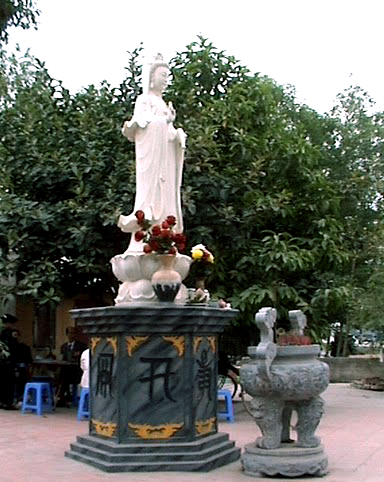
Overview & history
Chùa Trẻ, also known as Mục Ngưu Tự, has existed for over 300 years and is located in Yên Khê hamlet, Tiền Phong ward, Bắc Ninh province, Vietnam.
Tradition
According to ancient custom, Chùa Trẻ in Yên Khê hamlet was built through the joint efforts and contributions of the temple and the people of Yên Khê, with the purpose of worshipping wandering souls who have no one to acknowledge them. The pagoda enshrines three Buddha statues. In the centre is a statue of the Bodhisattva Avalokiteśvara (Quan Âm Bồ Tát). On either side are statues of the Holy Saints (Đức Thánh).
Because the pagoda is located far from the village, its care was often entrusted to young cowherds (mục đồng).
Every year, the 8th day of the 4th lunar month (Buddha's Birthday) is chosen as the memorial day for these unacknowledged souls. The villagers only organise a rice porridge offering called 'Cháo thí' and invite all the cowherd children to eat. Over many years, the villagers have maintained this practice, making it a custom of Yên Khê village, and thus the pagoda became associated with the name Chùa Trẻ (Pagoda of the Children or Pagoda of the Cowherds).
During the Resistance
During the resistance against the French colonialists, from 1949 to 1954, the area around Chùa Trẻ was densely wooded and had a favourable terrain for local guerrilla activities. Therefore, Chùa Trẻ Yên Khê was chosen as a very important outpost for the main army and local guerrillas from the six northwestern communes of Yên Dũng district.
This place was used to observe all movements of the enemy stationed in Phủ Lạng Thương town and surrounding areas. Many enemy raids from their base into the surrounding regions were detected in time from this important outpost, thus avoiding losses for the people in the enemy-occupied areas.
Additionally, the pagoda served as a gathering point for revolutionary cadres sent to operate, gather intelligence on the enemy, and build up the movement at the grassroots level, ensuring the safety of cadres before entering the village.
When the French discovered this highly effective outpost, they shelled it with artillery and mortars several times, but the Chùa Trẻ outpost still survived.
In 1953, when the French launched a large-scale raid on Song Khê commune with air and tank support, they levelled many of the village's cultural structures, including the pagoda.
Restoration Process
After peace was restored in 1958, the people of Yên Khê hamlet rebuilt Chùa Trẻ, mainly as a shelter for villagers from rain and sun, and as a resting place when working in the fields.
For a long period afterwards, the pagoda was not properly cared for or maintained, and there were no conditions for regular repairs, so the pagoda was completely ruined. Only the foundation and a more than 300-year-old ruối tree remained green all year round.
According to the wishes of the monks, nuns, and Buddhists of Hoa Khê Tự Pagoda and the determination of the people of Yên Khê to rebuild Chùa Trẻ, this wish was realised on the 2nd day of the 10th lunar month, Year of the Horse (6 November 2002), when reconstruction officially began, with the participation of local organisations and many villagers, as well as contributions from Buddhists near and far (head of the construction committee and village head: Trịnh Văn Thiết).
In January 2003, the project was handed over to Mr. Giáp Văn Nam, village head for the 2003–2005 term, and Mr. Nguyễn Văn Mỳ, Party cell secretary, continued to oversee the construction.
The pagoda was built on the old foundation and in the original orientation. It was completed on the 20th day of the 12th lunar month, Year of the Horse (22 January 2003).
The second restoration involved building the rear sanctuary. Construction began on the 9th day of the 11th lunar month, Year of the Tiger (14 December 2010).
The inauguration ceremony was held on the 23rd day of the 2nd lunar month, Year of the Cat (27 March 2011). Head of the construction committee and village head: Giáp Văn Nam. Party cell secretary: Trần Văn Yên.
Festival Day
The 8th day of the 4th lunar month every year. Buddha's Birthday Festival.
Photos
📷 Contribute photosVisiting tips
- Dress modestly; remove hats and keep quiet inside the main hall.
- Incense, flowers and offerings are usually sold right outside the gate; light an odd number of sticks (1 or 3).
- Most pagodas open from early morning to evening and are free to enter (some major sites charge a small scenic fee).
- Full-moon days, the 1st of the lunar month and Tet are very crowded; visit on weekday mornings for a quiet experience.
- Ask permission before photographing inside shrines; do not touch statues or altar objects.
Read more & references
Useful links to learn more before your visit:
Location
Coordinates: 21.24790, 106.16628
🧭 Directions on Google MapsReferences
Other pagodas in Bắc Ninh


