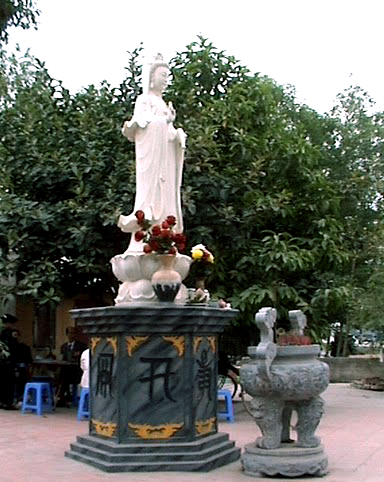
Hàm Long Pagoda
Bắc Ninh(Chùa Hàm Long)

Overview & history
Hàm Long Pagoda (chữ Hán: 寺含龍), also known as Long Hạm Tự (chữ Hán: 龍頷寺), is an ancient pagoda located in Thái Bảo quarter, Nam Sơn ward, Bắc Ninh province. The pagoda is situated about 7 km southeast of the centre of Bắc Ninh city. It was built in the 12th century during the Lý dynasty. The pagoda has been a patriarchal seat of Buddhism since the Revival period, belonging to the Liên Tông branch of the Trúc Lâm Zen sect. Currently, the abbot of the pagoda is Đại lão Hòa thượng Thích Thanh Dũng (secular name: Nghiêm Văn Dũng), who is also the Deputy Dharma Master cum Chief Secretary of the Council of Elders of the Central Committee of the Vietnam Buddhist Sangha, and Deputy Head cum Head of the Legal Affairs Committee of the Vietnam Buddhist Sangha in Bắc Ninh province.
Feudal Era
According to some of the current introductory boards at the pagoda, it was founded in 1158 by Lý Quốc sư Nguyễn Minh Không during the reign of King Lý Anh Tông. In the feudal era, the pagoda was located in Lãm Sơn Dương village, Lãm Sơn Nam canton, Quế Dương district, Từ Sơn prefecture, Kinh Bắc region. The pagoda was built more than half a century after Dạm Pagoda in nearby Lãm Sơn Trung village, and about a century after Phật Tích Pagoda in Tiên Du. However, in terms of scale and area at that time, the pagoda was not as large as Dạm Pagoda and Phật Tích Pagoda.
The pagoda is situated on a plot of land shaped like six sages gathering, in the form of the four sacred creatures (dragon, kylin, tortoise, phoenix). The southeast and southwest sides resemble the forms of a phoenix and a tortoise in worship. The northwest side is like a majestic tortoise bowing, with a stretch of Divine Dragon lowering its head towards the pagoda, hence the name Hàm Long (Dragon's Jaw). However, during the Lý and Trần dynasties, Hàm Long Pagoda did not yet have a large architectural scale.
At the beginning of the 18th century, during the Later Lê Restoration, a monk named Trịnh Hòa thượng, son of Tấn Quang vương Trịnh Bính, came to practise at the pagoda. His secular name was Trịnh Thập, his dharma name was Như Trừng, his monastic title was Lân Giác, and his epithet was Cứu Sinh. He was a disciple of Zen Master Chân Nguyên of Yên Tử mountain. He was the younger brother of Lord Trịnh Cương and son-in-law of the Retired Emperor Lê Hy Tông. Although he lived amidst luxury, his heart was always devoted to the Buddhist path. Later, he requested permission from the court to renounce the world and become a monk, converting his residence in Thọ Xương district into Liên Tông Pagoda for practice (now Liên Phái Pagoda). Afterwards, he also came to practise at Hàm Long Pagoda. During this period, the pagoda was renovated and expanded on a large scale with many structures: front hall, main sanctuary, patriarchs' hall, monks' quarters, stupa garden, etc. During his lifetime, he founded the Liên Tông branch of the Trúc Lâm Zen sect. Before passing away, he appointed Zen Master Tính Ngạn as abbot of Hàm Long Pagoda. After his nirvana (passing), Zen Master Như Trừng Lân Giác became the first patriarch among the 18 patriarchs of the Liên Tông branch worshipped at the pagoda.
In February 1928 (the 2nd year of the Bảo Đại era), the pagoda was renovated with contributions from monks, nuns, and Buddhists from 21 provinces across the country. This is recorded on the stele "Trùng tu Long Hạm tự bi" (Stele of the Renovation of Long Hạm Pagoda) erected on an auspicious day in the mid-spring month (仲春), i.e., the second month of the year Mậu Thìn.
Modern Era
In 1951, the architectural complex of the pagoda suffered major damage due to the policy of scorched earth resistance implemented by the Việt Minh authorities. During this period, when Dạm Pagoda was demolished, the statues of Consort Ỷ Lan and King Lý Nhân Tông were sent to Hàm Long Pagoda for safekeeping.
On 18 January 1988, the pagoda was recognised as a National Historical and Cultural Monument under Decision No. 28-VH/QĐ of the Ministry of Culture, signed by Deputy Minister Nông Quốc Chấn. The pagoda was recognised at the same time as several other monuments in the city, such as the Bắc Ninh Văn miếu (Temple of Literature), the temple of famous physician Nguyễn Phúc Xuyên, and the tomb of Quận công Bùi Nguyễn Thái, etc. Six years later, the pagoda was awarded a certificate of recognition as a monument, signed by Minister Trần Hoàn.
It was not until the 1990s, under the new abbot Thích Thanh Dũng, that the pagoda underwent significant restoration:
In 1995, he restored the patriarchs' hall.
In 1997, he restored the upper hall, the front hall, rebuilt four stupas in front of the gate, 16 guest rooms, and many other works.
At the end of 2000, the People's Committee of Bắc Ninh province issued a decision to establish the Bắc Ninh Provincial Intermediate Buddhist School, with its headquarters located within the grounds of Hàm Long Pagoda. Currently, Thượng tọa Thích Thanh Trung is the principal of this school.
In 2007, Nam Sơn commune, along with several other communes of Quế Võ district, was transferred to Bắc Ninh city, so the pagoda came under the jurisdiction of Bắc Ninh city and has remained so to this day.
On 20 March 2014 (i.e., 20/02 of the year Giáp Ngọ), the Executive Board of the Vietnam Buddhist Sangha in Bắc Ninh province, in cooperation with Hàm Long Patriarchal Pagoda, organised a groundbreaking ceremony to commence construction of auxiliary works for the pagoda, including the inner triple gate, landscape pond, rest pavilion, car park, etc., with a budget of about 40 billion VND.
Every year, on the 15th day of the 2nd lunar month, the pagoda organises a festival for a large number of Buddhists and local people to participate.
Architecture
Currently, the pagoda still preserves some ancient Buddha statues and 14 ancient stupas from the Trần, Later Lê, and Nguyễn dynasties. Among them are four remarkable bronze statues, notable for both artistic technique and bronze casting: the statue of Buddha Shakyamuni, 2.10 m high; the statues of Ananda and Kasyapa, each 1.86 m high (two of the ten great disciples of the Buddha); and the statue of Queen Maya, 1.58 m high (the Buddha's mother). All the statues were cast in bronze locally, exuding a very serene and composed aura, making every visitor feel light and peaceful when visiting the pagoda.
In addition, several pairs of parallel sentences (couplets) preserved at the pagoda reflect the Buddhist consciousness of the people of Bắc Ninh and provide some understanding of the historical journey the pagoda has undergone. Some notable pairs include:
At the front hall, on two brick pillars:
保嶺奇觀龍鳳龜麟鍾秀氣
含談曆史東西南北說名藍
Transliteration:
Bảo lĩnh kỳ quan long, phượng, quy, lân chung tú khí.
Hàm đàm lịch sử đông, tây, nam, bắc thuyết danh lam.
Provisional translation:
The precious mountain's marvellous sights—Dragon, Phoenix, Tortoise, Kylin—converge to create spiritual energy.
Discussing history, East, West, South, North, all speak of this famous site.
On the two bronze pillars in front of Ly trần viện:
阮國师修真伊然佛迹
鄭覺祖救劫自在神孚
Transliteration:
Nguyễn Quốc sư tu chân y nhiên Phật Tích.
Trịnh Giác tổ cứu kiếp tự tại Thần Phù.
Provisional translation:
National Master Nguyễn Minh Không practised the true path, his traces remain at Phật Tích Pagoda.
Elder Trịnh Giác saved the world, his presence lingers at the Thần Phù gateway.
At the rear sanctuary of Ly trần viện:
始開山於龍頷柱持鍾遇孔路國师之心法界當春而神接並域
初化盈於蓮派之禪中受戒珠安子之宗封繼措下於佛迹名篮
(男子冬; 孝靈九年造, 本邑茂材撰)
Transliteration:
Thủy khai sơn ư Long Hạm trụ trì chung ngộ Khổng Lộ quốc sư chi tâm pháp giới đương xuân nhi thần tiếp tịnh vực.
Sơ hóa doanh ư Liên Phái chi thiền trung thụ giới, Châu An Tử chi tông phong kế thố ư Phật Tích danh lam.
(Giáp Tý winter, Hiếu Linh ninth year created; compiled by Mậu Tài of this village).
Nhốt trùng
A rather unique aspect is that Hàm Long Pagoda is considered the largest centre for 'nhốt trùng' (imprisoning malevolent spirits) in the country. According to legend, since ancient times, the monks here have possessed very mysterious yet effective methods for suppressing 'trùng' (malevolent spirits). It is said that the safest place for 'nhốt trùng' is Hàm Long Pagoda.
The reason why Hàm Long Pagoda is believed by the people to have the ability to 'nhốt trùng' is that during the time of Patriarch Như Trừng, seeing that sentient beings were greatly fearful due to continuous deaths in families and clans—what is now called 'trùng tang' (serial deaths)—he was moved to write the Ten Vows to Save Lives Sutra for recitation, as well as woodblocks for printing talismans to help wandering souls attain liberation. In 1737, after his passing, his legacy was left in two stupas: a brick stupa containing his relics, and a stone stupa called the Như Trừng Lân Giác (Cứu Sinh) Patriarch's Stupa, which holds the fruits of his lifelong cultivation.
Planning
On 10 June 2016, Vice Chairman of the Provincial People's Committee Nguyễn Văn Phong signed Decision No. 659/QĐ-UBND approving the Master Plan for the conservation, restoration, and rehabilitation of the Dạm Pagoda - Hàm Long Pagoda monument cluster. According to this decision, the Hàm Long Pagoda area is divided into two protection zones:
Protection Zone 1, covering 0.98 ha, is defined as the entire current pagoda precinct and the ancient stupa garden from the feudal era. The principle is to preserve the status quo and repair any damage or deterioration, strictly adhering to the principles of monument conservation. Some items requiring restoration include: the triple gate, monks' quarters, corridor connecting the Patriarchs' Hall with the temple of Consort Ỷ Lan and the main sanctuary, etc.
Protection Zone 2, covering 1.61 ha, is the adjacent area in front of the pagoda, planned for new construction to enhance the value of the monument, including: inner triple gate, outer triple gate, car park, landscape pond, etc., and the access road system.
Photos
📷 Contribute photosVisiting tips
- Dress modestly; remove hats and keep quiet inside the main hall.
- Incense, flowers and offerings are usually sold right outside the gate; light an odd number of sticks (1 or 3).
- Most pagodas open from early morning to evening and are free to enter (some major sites charge a small scenic fee).
- Full-moon days, the 1st of the lunar month and Tet are very crowded; visit on weekday mornings for a quiet experience.
- Ask permission before photographing inside shrines; do not touch statues or altar objects.
Read more & references
Useful links to learn more before your visit:
Location
Coordinates: 21.14544, 106.10519
🧭 Directions on Google MapsReferences
- Vietnamese Wikipedia
- http://www.baoquangninh.com.vn/chinh-tri/201204/dong-chi-Bi-thu-Tinh-uy-tiep-nha-su-tru-tri-chua-Ham-Long-2164740/
- http://giadinh.net.vn/xa-hoi/trung-tang-va-nhung-bi-an-ve-ngoi-chua-nhot-trung-lon-nhat-viet-nam-20140515023829835.htm
- https://phatgiao.org.vn/danh-sach-thanh-vien-hdcm-ghpgvn-nhiem-ky-viii-2017-2022-d29269.html
- https://vbgh.vn/laws/detail/Quyet-dinh-chuan-y-nhan-su-Ban-tri-Su-GHPGVN-Tinh-Bac-Ninh-81/
- https://phatgiao.org.vn/truyen-ky-ve-thien-su-nhu-trung-lan-giac--vi-hoa-thuong-viet-bo-kinh-thap-nguyen-cuu-sinh-d35250.html
- http://skhdt.bacninh.gov.vn/web/so-noi-vu/news/-/details/57424/chua-ham-long-voi-nhung-kiet-tac-ve-hoanh-phi-cau-oi
- http://tpbacninh.bacninh.gov.vn/di-tich-lich-su-van-hoa
- http://www.daophatngaynay.com/vn/giao-duc/11408-Tinh-hinh-giao-duc-Tang-Ni-o-Bac-Ninh-xua-va-nay.html
- http://www.chinhphu.vn/portal/page/portal/chinhphu/hethongvanban?class_id=1&_page=1&mode=detail&document_id=22356
- http://www.hannom.org.vn/detail.asp?param=1858&Catid=789
- https://anninhthudo.vn/doi-song/noi-khiep-so-mang-ten-trung-tang-va-chuyen-ve-ngoi-chua-nhot-vong-lon-nhat-viet-nam/723267.antd
- https://www.google.com/maps/place/Ch%C3%B9a+H%C3%A0m+Long/@21.1440595,106.1054681,16z/data=!4m5!3m4!1s0x31350b9f54b1dc09:0x52607067062329f3!8m2!3d21.1454868!4d106.1052006
- https://phatgiao.org.vn/bac-ninh-khoi-cong-xay-dung-cong-trinh-phu-tro-chua-ham-long-d13882.html
- https://thanhnien.vn/du-lich/vieng-chua-ham-long-295417.html
- http://bacninh.gov.vn/documents/20182/8479458/659-Q%C3%90-UBND.signed.pdf
Other pagodas in Bắc Ninh