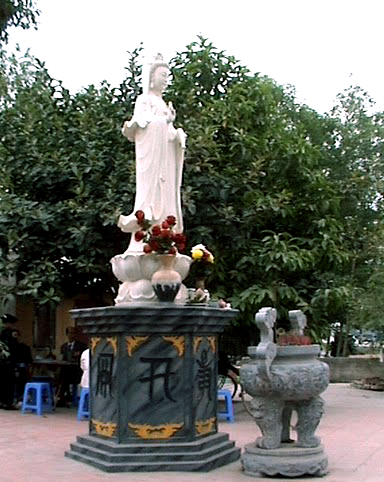
Đậu Pagoda (Bắc Ninh)
Bắc Ninh(Chùa Đậu (Bắc Ninh))

Overview & history
Đậu Pagoda is an ancient pagoda, formerly dedicated to Pháp Vũ, and is part of the Tứ Pháp (Four Dharmas) pagoda system in Trí Quả ward, Bắc Ninh province. The pagoda was completely destroyed during the Indochina War. Currently, there are two pagodas with the same name, Đậu Pagoda (both with the same Sino-Vietnamese name, Thành Đạo Tự), in two adjacent hamlets: one Đậu Pagoda in Đông Cốc neighbourhood, Song Liễu ward, and another Đậu Pagoda in Đại Tự neighbourhood, Song Liễu ward. In addition, there is also a Đậu Pagoda in Hà Nội (also named Thành Đạo Tự), which also worships Pháp Vũ.
Pháp Vũ
Pháp Vũ is one of the Tứ Pháp (Four Dharmas) of the Dâu region, or the Four Saints of the Southern Heavens, comprising Pháp Vân, Pháp Vũ, Pháp Lôi, and Pháp Điện. According to legend, when carving the four statues of the Dharma Buddhas from the sacred Dung tree that drifted on the Dâu River, it rained while carving the second statue, so that statue was named Pháp Vũ (the Buddha who governs rain). The Pháp Vũ statue was then brought to Đậu Pagoda (Thành Đạo Pagoda) for worship. The statue became renowned for its spiritual efficacy throughout Giao Châu, with its fame reaching even the Jin and Tang dynasties in China.
Documents such as the Cổ Châu Phật bản hạnh and Nam Thiên Tứ Thánh thực lục - cổ thuật bản mention Pháp Vũ with the full honorific: Đại Thánh Pháp Vũ Phật Tôn Thần. The imperial edict dated 24 November, 33rd year of Tự Đức (1880) for the deity in Đặng Xá hamlet, Đặng Xá commune (now Văn Xá commune), Kim Bảng, Hà Nam (the place that requested incense from Đậu Pagoda, Bắc Ninh to worship) states:
"Đại Thánh Pháp Vũ Phật Tôn Thần was originally bestowed the title Hoằng Chiêm Bác Thí Nhuận Vật Tư Sinh Diệu Hoá Thượng Đẳng Thần, who has helped the nation and the people with renowned spiritual efficacy. Now, continuing the bright mandate, remembering the deity's virtue, it is fitting to bestow the additional title Hoằng Chiêm Bác Thí Nhuận Vật Tư Sinh Diệu Hoá Tuý Mục Thượng Đẳng Thần, and still approve for Đặng Xá hamlet, Đặng Xá commune, Kim Bảng district to continue worshipping as before. May the deity protect our people. Obey this order."
The Tứ Pháp are only fully present in the Dâu region and Hưng Yên region; elsewhere, only a few individual pagodas worship all four deities. Among the Tứ Pháp, Pháp Vân and Pháp Vũ are the most widely worshipped.
History
Đậu Pagoda has the Sino-Vietnamese name Thành Đạo tự (成道寺), and is said to have been built in the 2nd century during the time of Governor Sĩ Nhiếp at Luy Lâu citadel, Giao Châu. The pagoda worships the Buddha and Pháp Vũ, popularly called Lady Đậu. This pagoda belongs to the Tứ Pháp system of the ancient Dâu region, associated with the legend of the Buddhist Mother Man Nương.
Thành Đạo Pagoda is located in Đông Cốc village, at the border with Đại Tự village. The pagoda became a communal place of worship for the people of both villages. They jointly took care of the pagoda, and during the annual Dâu festival, they cooperated in carrying Lady Đậu and participating in various competitions.
In 1948, Thành Đạo Pagoda was destroyed by the French, who took the land to build a military post and threw all the statues and ritual objects into the pond. At that time, the village chief named Bảo from Đại Tự village suggested that the people gather and petition the French official to allow them to take Lady Đậu to be temporarily worshipped at Dâu Pagoda.
In 1951, the People's Army of Vietnam attacked and destroyed the French post, and the pagoda was completely demolished. After peace was restored, the old Đậu Pagoda site was used to build a cooperative food storage warehouse.
In 1960, to ensure the cooperative agricultural production mechanism, the State took nearly twenty mẫu (Vietnamese acres) of Đông Cốc village's fields and handed them to the National Reserve Department to build a food storage warehouse. In 1968, after administrative boundary adjustments, the entire old Đậu Pagoda site became part of Đại Tự village, Thanh Khương commune.
In 1997, the people of Đông Cốc village rebuilt Thành Đạo Pagoda next to Đông Cốc đình (communal house), but this site is not the original location of the pagoda. That same year, the people of Đại Tự village also rebuilt Thành Đạo Pagoda on the original site to worship Lady Đậu.
Origin of the Dispute
The Pháp Vũ statue is one of the four Tứ Pháp statues (Pháp Vân, Pháp Vũ, Pháp Lôi, Pháp Điện) carved in the 18th century in the Indian style, possessing unique aesthetic and spiritual cultural value. The set of statues was recognised as a National Treasure in the 6th batch in 2017. The Pháp Vũ statue is currently located at Dâu Pagoda (Đại Tự neighbourhood, Thanh Khương ward, Thuận Thành town, Bắc Ninh province).
The Dâu Festival takes place over three days and is the common festival of the Dâu district, comprising 12 villages in the Luy Lâu area that worship the Tứ Pháp system. The most distinctive and important ritual of the Dâu Festival is the procession of the four statues to the Ancestral Pagoda in Mãn Xá village to "pay homage" to the Buddhist Mother Man Nương. Since the 1960s, the two villages of Đông Cốc and Đại Tự have both participated in the procession of Lady Đậu during the festival.
Since both Đông Cốc and Đại Tự villages rebuilt Thành Đạo Pagoda to worship Pháp Vũ and both wanted to bring the Pháp Vũ Buddha statue back for worship, a dispute over ownership of the statue arose. In 1997, after rebuilding the pagoda, Đông Cốc village was granted permission by the abbot of Dâu Pagoda and the Tổng Dâu Association (comprising villagers from three communes: Thanh Khương, Hà Mãn, Trí Quả) to bring the Pháp Vũ statue back for worship. However, when Dâu Pagoda prepared its heritage dossier in the 1960s, the Lady Đậu statue was listed among 101 statues as the private property of Dâu Pagoda, and Dâu Pagoda was recognised by the Minister of Culture as a heritage site for the entire North (equivalent to national level today) under Decision No. 313-VH/VP (dated 28 April 1962). As the statue is the property of a ranked heritage site, the Ministry of Culture's permission is required to transfer ownership. However, after Đông Cốc village submitted a petition, approval has not been granted, so the Pháp Vũ statue remains at Dâu Pagoda to this day.
On 22 April 2009, the People's Committee of Thuận Thành district, in coordination with the Department of Heritage (Ministry of Culture, Sports and Tourism), organised a seminar on Đậu Pagoda (i.e. Thành Đạo Tự). The seminar heard the opinions of Professor Dr. Trần Lâm Biền and Dr. Nguyễn Hữu Toàn, Deputy Director of the Department of Heritage, both of whom stated: "The Pháp Vũ Buddha must be worshipped at Đậu Pagoda in accordance with the Heritage Law...".
Current Situation
The reason there has been no decision from the cultural management authorities is that the dispute now involves three parties, each with their own arguments as follows:
Đậu Pagoda in Đông Cốc village, although not built on the original Đậu Pagoda land, still preserves three imperial edicts from the Nguyễn dynasty:
- Edict conferring the title on Đức Pháp Vũ in the 33rd year of Tự Đức (1880), together with the Thành Hoàng (Village Tutelary Deity) of Đông Cốc village.
- Edict conferring the title on Đức Pháp Vũ in the 2nd year of Đồng Khánh (1887), together with the Thành Hoàng of Đông Cốc village.
- Edict conferring the title on Đức Pháp Vũ in the 3rd year of Duy Tân (1909), together with the Thành Hoàng of Đông Cốc village.
Đậu Pagoda in Đại Tự village is built on the original site of Đậu Pagoda and therefore claims the right to worship the statue as the land falls within Đại Tự village's boundaries.
Dâu Pagoda is the current owner of the statue, with the heritage dossier and the Ministry of Culture's decision, and has kept the statue from 1948 to the present.
Furthermore, the People's Committee of Thuận Thành district (now Thuận Thành town) concluded that Đậu Pagoda in Đông Cốc village and Đậu Pagoda in Đại Tự village are both illegally constructed buildings. Đậu Pagoda in Đông Cốc village is also an illegal construction encroaching on the protected area of the ranked historical site of Đông Cốc đình (communal house), so permission was not granted to transfer the statue to a building without land allocation, architectural approval, or construction permit. The Thuận Thành district authorities proposed that Hà Mãn commune and Thanh Khương commune (now Hà Mãn ward and Thanh Khương ward) complete procedures to restore Thành Đạo Pagoda and establish a heritage management board for Thành Đạo Pagoda before agreeing to transfer the Pháp Vũ statue.
The dispute has lasted for more than 20 years. At the 1998 Dâu Festival, there were rumours that Đông Cốc villagers planned to secretly steal the Lady Đậu statue during the procession, so the statue procession ritual at the Dâu Festival has been cancelled ever since. The ongoing conflict and dispute have caused fights between people from Đông Cốc and Đại Tự villages to break out almost every year during the Dâu Festival procession.
Both villages have repeatedly petitioned Dâu Pagoda and the authorities to transfer Lady Đậu to their village pagoda, but without success. The situation has become even more deadlocked since Dâu Pagoda was recognised as a special national heritage site and the set of statues was recognised as a National Treasure.
Photos
📷 Contribute photosVisiting tips
- Dress modestly; remove hats and keep quiet inside the main hall.
- Incense, flowers and offerings are usually sold right outside the gate; light an odd number of sticks (1 or 3).
- Most pagodas open from early morning to evening and are free to enter (some major sites charge a small scenic fee).
- Full-moon days, the 1st of the lunar month and Tet are very crowded; visit on weekday mornings for a quiet experience.
- Ask permission before photographing inside shrines; do not touch statues or altar objects.
Read more & references
Useful links to learn more before your visit:
Location
Coordinates: 21.03587, 106.04252
🧭 Directions on Google MapsReferences
- Vietnamese Wikipedia
- https://tuoitre.vn/bao-vat-luu-lac-cua-nha-chua-noi-niem-ba-dau-20180716101056415.htm
- https://giacngo.vn/phatdan2018/phatdankhapnoi/2018/05/22/5BF698/
- https://phatgiao.org.vn/vi-sao-tuong-phap-vu-tai-chua-dau-chua-duoc-ve-nha-d8779.html
- https://thuvienphapluat.vn/van-ban/Van-hoa-Xa-hoi/Quyet-dinh-313-VH-VP-xep-hang-nhung-di-tich-danh-thang-canh-toan-mien-Bac-19864.aspx,
- http://vanban.chinhphu.vn/portal/page/portal/chinhphu/hethongvanban?class_id=2&mode=detail&document_id=171227
- https://vanban.sav.gov.vn/2302-1-ddt/quyet-dinh-so-2089qdttg-ngay-25122017-cua-thu-tuong-chinh-phu-ve-viec-cong-nhan-bao-vat-quoc-gia-dot-6.sav
- https://disanvanhoathuanthanh.vn/Tourism/Places/6/Chua-To.html
- http://dangxahanam.blogspot.com/2018/05/giu-gin-ban-sac-tho-phat-phap-vu-cua.html
- https://phatgiao.org.vn/phong-vhtt-huyen-thuan-thanh-tra-loi-don-xin-lai-tuong-phap-vu-cua-nhan-dan-thon-dong-coc-d10319.html
- https://phatgiao.org.vn/nguyen-vong-tho-tuong-phap-vu-cua-nhan-dan-thon-dong-coc-bao-gio-thanh-hien-thuc-d13616.html
- https://web.archive.org/web/20200608132629/https://vanban.sav.gov.vn/2302-1-ddt/quyet-dinh-so-2089qdttg-ngay-25122017-cua-thu-tuong-chinh-phu-ve-viec-cong-nhan-bao-vat-quoc-gia-dot-6.sav
Other pagodas in Bắc Ninh