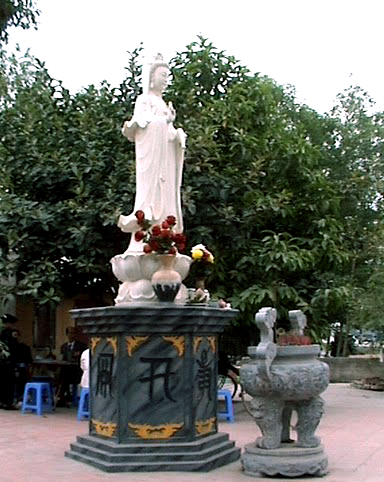
Dàn Pagoda
Bắc Ninh(Chùa Dàn)
Overview & history
Dàn Pagoda (its formal name is Trí Quả Tự) is also known as Dàn Phương Quan Pagoda or Dàn Câu Pagoda. It is a pagoda belonging to the Tứ Pháp (Four Dharmas) system, and is said to have been built in the 2nd century. The pagoda is located in Phương Quan quarter, Trí Quả ward, Bắc Ninh province.
Name
The formal name of the pagoda is Trí Quả Tự (Chinese characters: 智果寺), which is the same as the name of Trí Quả ward. However, the name of the pagoda likely existed before the name of the ward. The book Thiền Uyển Tập Anh already mentions a Zen master practising at this pagoda during the Lý dynasty:
The pagoda is commonly called Dàn Pagoda, a shortened form of Dàn Câu Pagoda, after the vernacular name of Phương Quan village (Dàn Câu village). However, about 800 metres from the pagoda, also in Trí Quả ward, there is another pagoda in Xuân Quan quarter (Dàn Chợ village) also called Dàn Pagoda, so this pagoda is called Dàn Phương Quan Pagoda or Phương Quan Pagoda to distinguish it. The pagoda is located right next to the communal house (đình) of Dàn Câu village, so the two are often referred to together as the Dàn đình-pagoda complex.
Pháp Điện
Dàn Câu Pagoda is the main place of worship for Pháp Điện, also known as "Đại Thánh Pháp Điện Phật" (Great Saint Pháp Điện Buddha), the fourth in the Tứ Pháp, who presides over Lightning (Chinese character: 電 - điện), and is closely associated with the legend of Phật Mẫu Man Nương. In the past, Sĩ Nhiếp had Man Nương retrieve a mulberry tree from the river in front of Luy Lâu citadel, which was then carved into four Buddha statues. When carving the fourth statue, lightning struck, so it was named Pháp Điện, and the Trí Quả Pagoda was built for worship. The vernacular name of the village is Dàn, so Pháp Điện is also called Lady Dàn (Bà Dàn). Along with Lady Dâu, Lady Đậu, and Lady Tướng, the people consider the Tứ Pháp as four sisters: Lady Dâu is the eldest, Lady Đậu the second, Lady Tướng the third, and the youngest is Lady Dàn.
The pagoda still preserves imperial decrees from the first year of Chiêu Thống (1786) and the second year of Bảo Hưng (1802), conferring titles on Phật Pháp Điện and two village tutelary deities in the Dàn Câu communal house:
Phật Pháp Điện: Đại thánh Pháp Điện dực thánh bản cảnh tuệ tĩnh tôn thần
Village tutelary deity: Thiên quang linh ứng đại vương
Local Earth deity: Thổ kỳ linh ứng đại vương
The Pháp Điện statue that remains today dates to about the 18th century and was recognised as National Treasure No. 10, batch 6 (2017), together with the other three Tứ Pháp statues. The statue is 1.7 metres tall, seated in meditation on a lotus pedestal, with a gentle, benevolent face, high cheekbones, painted bright red, bright eyes, arched eyebrows, a mischievous smile, the right hand raised, the left hand resting on the thigh, and a pearl in the palm. As the youngest sister, Lady Dàn is sculpted with the freshest and most cheerful face among the Tứ Pháp statues.
During the statue procession at the Hội Dâu festival, Lady Dàn’s palanquin must go last, and because Lady Dàn is mischievous, her palanquin always has to wait until the others have gone a long way ahead before following, as on the way she will have the palanquin run wildly, turning right and left, and then running very fast. The procession of Lady Dàn’s palanquin must also be accompanied by a "stick dance" to clear the way for the procession and to claim land for the festival. Thirty-two strong young men from Dàn village are assigned to form a group, each carrying a bamboo stick (if the bamboo stick is wrapped in red paper it is called "hồng côn"; if it is a "bánh tẻ" bamboo stick rubbed with salt and sun-dried until white, it is called "bạch trượng"), and as they go, they perform a fast, vigorous dance to clear the way.
Architecture
No traces of Dàn Pagoda from the period of Northern Domination remain. The existing architecture dates to the Lê Trung Hưng and Nguyễn periods. The most recent restoration was in 2017. The current heritage complex consists of the pagoda and Dàn communal house (đình) connected in the "front Thần, rear Buddha" style, including: the Tam Quan (three-entrance gate), Phương Đình (square pavilion), Tiền Tế (front ceremonial hall), Ống Muống (connecting corridor), Thượng Cung (upper sanctuary); at the back are the Tam Bảo Hậu (rear Buddha hall), Tổ House (ancestral hall), Mẫu House (Mother Goddess hall), stupa garden, and surrounding trees.
Directly behind the Tam Quan is the rather grand Nguyễn-era Phương Đình, built in the two-storey, eight-roofed style with curved eaves, recently restored.
The main worship area of the pagoda includes:
The Tiền Tế (also called Đình Thượng) still preserves intact the architecture of the Lê–Nguyễn period. The Tiền Tế is large, with an area of 21m x 9m, consisting of five bays and two wings, with four sharply curved corners, tiled roof, the ridge decorated with "Two Dragons Flanking the Moon", and large dragon heads at the ends; the corners are gracefully curved, decorated with dragon and phoenix motifs; the eaves are adorned with kneeling lions. The framework is made of large, sturdy ironwood (the main columns are 1.30m in circumference, the secondary columns 0.85m), with a "con chồng giá chiêng" (interlocking beam and bracket) roof structure, mortised into the longitudinal and transverse columns, connected with the system of beams, purlins, and brackets.
On architectural elements such as beam ends, brackets, and supports are finely carved Tứ Linh (Four Sacred Animals). Especially, the beam ends are carved into large dragon heads using the deep-relief technique, with wide-open mouths revealing a pearl, manes and whiskers flying horizontally, in the artistic style of the Later Lê period. In the central bay stands an ancient altar table with "quỳ" (kneeling) legs, finely carved; the right bay houses the altar of the "Patron of the Craft" who taught the villagers the craft of making fishhooks.
Ống Muống is a long building connecting the Tiền Tế and Thượng Cung, with a framework of beams, columns, and corner brackets, measuring 7.30m x 8.10m, consisting of three bays, with an ironwood frame connected by longitudinal and transverse columns (main columns 1.0m in circumference, secondary columns 0.68m). The partition between Ống Muống and Thượng Cung is a set of sacred doors decorated with dragon and cloud motifs. In Ống Muống are the shrine and ancestral tablets of the village tutelary deity.
Thượng Cung connects to Ống Muống, consisting of one bay and two wings with four curved roofs, the ridge decorated with "Two Phoenixes Facing Each Other" in a unique style. The framework is made of sturdy ironwood, connected by the roof beams and longitudinal and transverse columns (main columns 1.35m in circumference, secondary columns 1.0m). On the main beam is still the Chinese inscription recording the restoration during the reign of Emperor Thành Thái (1903):
Thành Thái, 14th year, 11th month, 16th day, year of Nhâm Dần, 12th month, 16th day, raising the main beam, auspicious occasion.
At the rear is the Tam Bảo Hậu with Nguyễn-era architecture, built in the "chuôi vồ" (mallet-handle) style, consisting of seven bays in the front hall and three bays in the upper sanctuary, with a sturdy ironwood frame; the roof uses the "con chồng, giá chiêng" structure connected to the system of columns, beams, and brackets. The Tam Bảo Hậu houses later generations of statues and is arranged like other village pagodas. In addition, there are other structures such as the Tổ House, Mẫu House, monks’ quarters, stupa garden, etc., forming a heritage complex.
The pagoda also has four steles dating from the Nguyễn dynasty.
Photos
📷 Contribute photosVisiting tips
- Dress modestly; remove hats and keep quiet inside the main hall.
- Incense, flowers and offerings are usually sold right outside the gate; light an odd number of sticks (1 or 3).
- Most pagodas open from early morning to evening and are free to enter (some major sites charge a small scenic fee).
- Full-moon days, the 1st of the lunar month and Tet are very crowded; visit on weekday mornings for a quiet experience.
- Ask permission before photographing inside shrines; do not touch statues or altar objects.
Read more & references
Useful links to learn more before your visit:
Location
Coordinates: 21.04389, 106.03450
🧭 Directions on Google MapsReferences
- Vietnamese Wikipedia
- https://thuvienhoasen.org/p55a10801/phan-ii-07-thien-uyen-tap-anh-ngu-luc-quyen-ha
- https://www.youtube.com/watch?v=L8Wl8GMMS40
- http://disanvanhoathuanthanh.vn/Tourism/Places/8/Chua-Dan.html
- http://www.hids.hochiminhcity.gov.vn/c/document_library/get_file?uuid=3dc12445-2b62-470a-b6fe-6a64d9bc9648&groupId=13025
- http://www.hannom.org.vn/detail.asp?param=572&Catid=486
- https://tools.wmflabs.org/geohack/geohack.php?language=vi&pagename=Ch%C3%B9a_D%C3%A0n¶ms=21.044022_N_106.034565_E_type:landmark
Other pagodas in Bắc Ninh