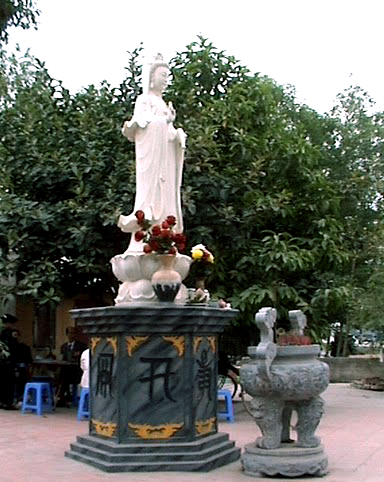
Dạm Pagoda
Bắc Ninh(Chùa Dạm)

Overview & history
Dạm Pagoda, also known as Rạm Pagoda, with the formal name Đại Lãm Thần Quang Tự, is also called Bà Tấm Pagoda, Cao Pagoda, or Trăm Gian Pagoda (because in the past the pagoda had 100 compartments, but it is not the Trăm Gian Pagoda located in Hanoi), and is also referred to as Lãm Sơn Pagoda, after the name of the mountain. The pagoda leans against Dạm Mountain, facing the Đuống River, formerly located in Lãm Sơn Trung village, Lãm Sơn Nam canton, Quế Dương district (now Nam Sơn ward, Bắc Ninh province). It is a great scenic site from the Lý dynasty and is now an important relic of Bắc Ninh province with a history of nearly 1,000 years.
Lý and Trần Dynasties
According to historical records and books such as Việt sử lược, Đại Việt sử ký toàn thư, Đại Nam nhất thống chí, and Lịch triều hiến chương loại chí, in the first year of Quảng Hựu (1085), Lady Ỷ Lan, a consort of the Lý dynasty, while touring Đại Lãm Sơn, intended to build a pagoda.
In 1086, the Lý court ordered the construction of the pagoda. The following year, 1087, King Lý Nhân Tông visited the pagoda under construction, held a banquet, and composed the poem "Lãm Sơn dạ yến" (Night Banquet at Lãm Sơn). After ten years of construction, in 1094 Dạm Pagoda was completed, and the king bestowed the name Cảnh Long Đồng Khánh Pagoda, granted 300 mẫu (about 108 hectares) of temple land for the pagoda's income, and assigned seven families at the foot of the mountain to be responsible for opening and closing the pagoda gates. In 1105, three stone stupas were built at Lãm Sơn Pagoda.
For a long time afterwards, the pagoda always received special attention from the royal court, so it was further expanded and embellished. King Trần Nhân Tông once visited, praising in verse the architectural scene of twelve successive layers.
After the Resistance against the French, 1946
According to local people, in 1946–1947, when the French colonial army stationed here, the local people burned the pagoda as part of the scorched earth resistance. The village elders still remember: "The pagoda burned for several days before it was gone. On the night the pagoda burned, a storm arose, swirling dust and smoke everywhere, and the villagers, terrified, told each other that they must rebuild the pagoda in the future to avoid offending the deities. When the pagoda was destroyed, the statues of Lady Ỷ Lan and King Lý Nhân Tông were sent to Hàm Long Pagoda nearby, so they have been preserved to this day. All other relics and antiques were lost, so the people consider these two ancient statues as treasures."
However, from then until 2008, the pagoda was never restored to its former appearance. The original 100 compartments have now been replaced by three small halls for worshipping Buddhist deities (on the third terrace) and three halls (on the fourth terrace) for worshipping the two remaining ancient statues of Lady Ỷ Lan and King Lý Nhân Tông. Both the new pagoda and temple were built in 1996, funded by local people.
Regarding the grandeur of Dạm Pagoda, folk tradition has preserved the following verse:
"On the fifteenth, the moon hides,
on the sixteenth, the moon hangs,
on the seventeenth, beds and mats are tidied,
on the eighteenth, Dạm Pagoda closes its doors,
on the nineteenth, there is reluctance,
on the twentieth, good dreams,
on the twenty-first, midnight..."
These are the times when the moon rises. "On the eighteenth, Dạm Pagoda closes its doors" means that on the eighteenth day, the moon rises at the time when Dạm Pagoda closes its doors.
The festival of Dạm Pagoda is held on the 8th day of the 9th lunar month, when the villages around Dạm Pagoda joyfully hold festivities and have the custom of carrying the palanquin of the village tutelary deity up to Dạm Pagoda to pay homage to the Holy Mother (or Lady King Ỷ Lan).
Topography
The land of Nam Sơn has the Dạm mountain range, formally called Đại Lãm Sơn, which rises abruptly, standing out amidst fields, ponds, rivers, streams, and sandbanks, forming a magnificent natural landscape. The villages lying around the foot of Dạm Mountain are called the "Dạm villages", including: Triều Thôn, Sơn Trung, Tự Thôn, and Môn Tự Thái Bảo.
Architecture
Comparing the grandeur of Dạm Pagoda and Phật Tích Pagoda, it is said that Dạm Pagoda is much larger, as it was built later and learned from the experience of Phật Tích Pagoda. The pagoda covers an area of over two Bắc Bộ mẫu (about 7,200 m²), with four terraces rising gradually along a 120 m axis following the slope of Dạm Mountain, and a platform width of 70 metres.
All the terraces have stone embankments to prevent erosion, with slightly flared bases, sloping at about 70 degrees and 5–6 m high. The path down each terrace consists of 25 stone steps. The stones used were quarried locally and hewn square like bricks about 50–60 cm long and wide. The terraces are connected by stone-paved steps. On the terraces are Lý dynasty tiles with dragon, phoenix, lotus vine, and chrysanthemum vine motifs. The stone column bases, 0.75 m x 0.75 m, are artistically carved with lotus petals in relief.
Ascending the first terrace, called Bãi Hội by locals, visitors enter through a single gateway, with high steps and a landing 16 m wide.
The second terrace has three narrower entrances with lower steps. The third and fourth terraces each have only two narrow entrances. The stone embankment of the second terrace is the main pagoda platform. The stonework is carved with water wave patterns, the motifs deeply incised and prominent. On this terrace, between the three entrances, to the right of the pagoda is a square plot of land, 7 m per side, 2 m high, with stone embankments carved with Lý dynasty water wave motifs.
On this square plot on the second terrace stands a stele on a turtle base. The stele is 1.5 m high and 1 m wide. The entire face of the stele is worn and faded, with only the two large, deep characters "信施, tín thí" (faithful offering) remaining on the back. The border of the stele has vine motifs, probably carved later, around the 16th century. Opposite this square plot, across the central entrance, on the left is a raised circular plot, about 4.5 m in diameter and 1 m high, also with Lý dynasty water wave stone carvings.
On top of this circular plot stands a large monolithic stone pillar, nearly 5 m high (not counting the buried portion). The pillar is made of two blocks, symbolising the square and round forms of earth and heaven. The base is a square box, with sides of 1.4 m and 1.6 m. The cylindrical block sits atop the square base, about 1.3 m in diameter. The lower part of the cylinder is carved in relief with a pair of dragons in the Lý style, their heads raised high towards a shining pearl, bodies coiled around the pillar, tails intertwined. The dragons resemble the snake-like Lý dynasty dragons, with flaming crests, manes like fluttering pennants, rounded bodies twisting nimbly, and bird-like feet with five claws. The dragons stand out amid intricate vine motifs. The dragon bodies are thick and coiled around the pillar. The two front claws are sharp and raised, holding the pearl under the chin.
The stone pillars of Dạm Pagoda are extremely distinctive and grand in scale, attracting attention from afar and appearing even more beautiful up close. Some researchers believe these pillars are Việt-ised representations of the Linga and Yoni fertility symbols. The pillars embody wishes for favourable weather and a prosperous, peaceful life.
This second terrace also has the Bống well, which folklore says is where Tấm from the folk tale Tấm Cám raised her bống fish.
The third and fourth terraces have traces of the pagoda and temple dedicated to Tấm and Lady Ỷ Lan. Here there is also a small stone stele, inscribed in the 17th year of Chính Hòa of the Lê dynasty (1696), 0.65 m high and 1.4 m wide. The stele "Đại Lãm Thần Quang tự tân tạo Hộ pháp" records that previously the pagoda had no Dharma Protector and that thousands of people performing good deeds had restored the pagoda and added statues.
In addition, at the Dạm Pagoda site, the head of a Kim Cương stone statue has been found. Large stone column bases with beautiful Lý dynasty carvings and many terracotta fragments shaped like ducks, dragons, and flowers also remain.
Preservation
With the above historical and artistic values, the temple and pagoda of Dạm, dedicated to Tấm and Lady Ỷ Lan, were classified as a historical and cultural relic by the Ministry of Culture and Information of the Democratic Republic of Vietnam in 1962.
Currently, Dạm temple and pagoda are in a seriously deteriorated state, and some structures built by local people through self-mobilisation and contributions do not yet meet the requirements for restoration and preservation of this particularly valuable monument.
Photos
📷 Contribute photosVisiting tips
- Dress modestly; remove hats and keep quiet inside the main hall.
- Incense, flowers and offerings are usually sold right outside the gate; light an odd number of sticks (1 or 3).
- Most pagodas open from early morning to evening and are free to enter (some major sites charge a small scenic fee).
- Full-moon days, the 1st of the lunar month and Tet are very crowded; visit on weekday mornings for a quiet experience.
- Ask permission before photographing inside shrines; do not touch statues or altar objects.
Read more & references
Useful links to learn more before your visit:
Location
Coordinates: 21.14451, 106.10223
🧭 Directions on Google MapsReferences
- Vietnamese Wikipedia
- http://www.bacninh.gov.vn/Story/VanHoaDuLich/NetVanHoaKinhBac/2005/6/659.html
- http://www.bacninh.gov.vn/Story/VanHoaDuLich/DiTichDiSanVanHoa/2007/6/8785.html
- http://www.vnn.vn/vanhoa/2008/06/788665/
- http://www.bacninh.gov.vn/Story/VanHoaDuLich/DiTichDiSanVanHoa/2006/10/6576.html
- http://www.giacngo.vn/vanhoa/2008/05/20/77D611/
- http://webcache.googleusercontent.com/search?q=cache:r7IJrk-UwlEJ:www.bacninh.gov.vn/Uploaded/phuong/2010/CB%25203%2B%25204/05.doc+%22ch%C3%B9a+r%E1%BA%A1m%22&cd=1&hl=en&ct=clnk&gl=us
- https://web.archive.org/web/20090703052705/http://www.giacngo.vn/vanhoa/2008/05/20/77D611
- https://web.archive.org/web/20100812075149/http://www.bacninh.gov.vn/Story/VanHoaDuLich/NetVanHoaKinhBac/2005/6/659.html
- https://web.archive.org/web/20100726103407/http://www.bacninh.gov.vn/Story/VanHoaDuLich/DiTichDiSanVanHoa/2007/6/8785.html
- https://web.archive.org/web/20100124052420/http://www.bacninh.gov.vn/Story/VanHoaDuLich/DiTichDiSanVanHoa/2006/10/6576.html
Other pagodas in Bắc Ninh