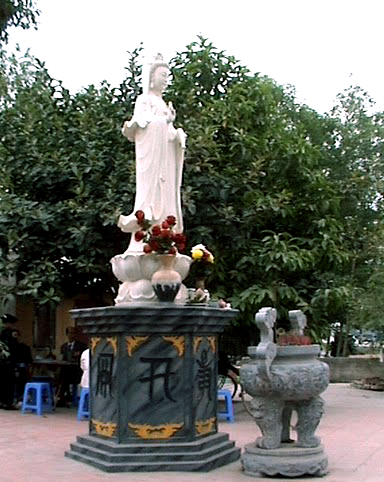
Cổ Pháp Pagoda
Bắc Ninh(Chùa Cổ Pháp)
Overview & history
Cổ Pháp Pagoda (literary name: Cổ Pháp tự (古法寺)) is a pagoda located in Đại Đình quarter, Từ Sơn ward, Bắc Ninh province, Vietnam. Cổ Pháp Pagoda is also known as Tương Giang Pagoda, and is a Tổ đình (ancestral monastery), the Buddhist centre of the Tì Ni Đa Lưu Chi sect.
History and Sacred Legends
Name of Cổ Pháp Pagoda: According to the books Thiền uyển tập anh and Việt Nam Phật giáo Sử luận, the name Cổ Pháp was given by the 8th patriarch of the Tì Ni Đa Lưu Chi sect, Định Không, who renamed it after his homeland (hương, village of Cổ Pháp). The story is as follows: Around the Tang dynasty's Zhenyuan era (785–805), when Patriarch Định Không built Quỳnh Lâm Pagoda in the area, during the digging of the pagoda's foundation, a censer and ten bronze bells were found. The patriarch ordered someone to take them to the river to wash, but one bell fell into the river and drifted until it came to rest on the riverbed. The patriarch said:
Ten mouths are ten mouths (Thập is ten, Khẩu is mouth); the character Thập [十] placed atop Khẩu [口] forms the character Cổ [古] (meaning old, ancient); Thủy khứ means going into water (Thủy is water, Khứ is to go), the character Thủy [氵] placed next to Khứ [去] forms the character Pháp [法] (meaning Dharma or law). The character Thập [十] placed above Nhất [一] forms the character Thổ [土] (earth), meaning ten pieces, losing one piece means returning to the earth and drifting towards our hương (village), so the name of hương Diên uẩn (Diên Uốn) was changed to hương Cổ Pháp. If read in Sino-Vietnamese, Cổ Pháp means ancient rites, ancient laws. If read in the vernacular, Pháp cổ means Dharma drum. Dharma drum means the sound of the Buddha preaching the Dharma resounding like a drum, literally meaning the flourishing of the Buddha Dharma. The old Kinh Bắc region also had Cổ Loa (ancient spiral rampart), Cổ bi (ancient stele). Then the patriarch composed the following verse:
The earth offers Dharma instruments – First-class pure bronze
When the Buddha Dharma prospers – The village is named Cổ Pháp.
(Địa trình pháp khí – Nhất phẩm trinh đồng
Tri Phật pháp chi long hưng – Lập hương danh chi Cổ Pháp)
There is also another poem:
Dharma instruments appear – Ten bronze bells
The Lý clan becomes king – First merit of the Three Grades.
(Pháp lại xuất hiện – Thập khẩu đồng chung
Lý thị hưng vương – Tam phẩm thành công)
And another poem:
Ten go into the water and earth – Cổ Pháp is our village's name
A chicken sits on the back of a phoenix – The Three Jewels will flourish.
(Thập khẩu thủy thổ khứ – Cổ Pháp danh hương hiệu
Kê cư loan nguyệt hậu – Chính thị hưng Tam bảo)
According to historical records and some research, Cổ Pháp Pagoda previously belonged to hương (village) Diên uẩn (hương Diên Uốn, hương Cổ Pháp), Cổ Pháp district (later called Cổ Lãm in the Lý period), Từ Sơn prefecture, Kinh Bắc region, later part of Đại Đình hamlet (the royal court's headquarters) or Đình Sấm, Dương Lôi; the vernacular name is Nuốn (possibly derived from Diên Uốn); later it belonged to Đông ngàn district (later renamed Từ Sơn district). Cổ Pháp Pagoda is located in an area with many famous rivers such as the Tiêu Tương river (Tương giang) with the tragic love story of Trương Chi the flute player and princess Mỵ Nương, the Thiên Đức river, the Tào Khê river (where the sixth patriarch of the Zen sect, Huineng, practised at Mount Tào Khê), forests, Đại Sơn mountain, and Dặn Pagoda, Lục Tổ Pagoda with a golden statue of (Sixth Patriarch Huineng of Tào Khê)...
Hương Cổ Pháp is the homeland of King Lý Công Uẩn, the birthplace of the Lý dynasty, and is associated with patriarchs: Định Không, Thông Thiện, La Quý An, Thiền Ông, Vạn Hạnh, Khánh Văn... and the pagodas here are Cổ Pháp Pagoda, Lục Tổ Pagoda (i.e. Tiêu Pagoda – Thiên Tâm tự on Tiêu mountain in Tương Giang commune, formerly Dịch Bảng), Dận Pagoda (in Đình Bảng commune). Whether King Lý Công Uẩn was born and raised at the village pagoda – his mother's (Phạm Thị) home pagoda, Cổ Pháp Pagoda, or at Dận Pagoda (Đình Bảng) is still debated. However, historical records suggest that Lady Phạm Thị was a nun at Tiêu Pagoda (then under Patriarch Vạn Hạnh), and when she went into labour, she reached Dận Pagoda (meaning 'warned of birth'), but only gave birth to King Lý Công Uẩn upon returning to Cổ Pháp Pagoda. Cổ Pháp Pagoda is where King Lý Công Uẩn was born and raised (Patriarch Vạn Hạnh entrusted Patriarch Khánh Văn to raise him).
According to Thiền uyển Tập anh and Việt Nam Phật giáo Sử luận, before his death, Patriarch Định Không instructed his disciple Thông Thiện (or Thông Biện): This land of Cổ Pháp is important, in the future, there may be strange people coming to destroy it, so it must be carefully protected... If this land is destroyed, great men will not appear to save the country and make the Dharma flourish. Before passing away, Patriarch Thông Thiện gave the same advice to his disciple La Quý An. Patriarch La Quý An believed that when Cao Biền built Đại La citadel, he had 19 ponds dug in this area (now Phù Chẩn commune) to destroy the imperial aura of Cổ Pháp land, so he had the 19 ponds filled in. He also had a golden statue of Sixth Patriarch Huineng cast and planted a kapok tree at Minh Châu Pagoda (or Gia Châu, Cha Lư) to suppress (in the year Bính Thân – 936) and left the following prophecy:
On the dragon's head mountain appears – The snake's tail hides the Minh Châu pearl
Eighteen young men will surely succeed – When the dragon form appears on the kapok tree
In the rat month, chicken day, rabbit hour – The sun shines brightly in the blue sky.
(Đại sơn long đầu khởi – Xà vĩ ẩn minh châu
Thập bát tử định thành [combining to form the character Lý] – Miên thọ hiện long trình
Thố kê thử nguyệt nội – Định kiến nhật xuất thanh)
The Đại Việt Sử ký Toàn thư states that lightning struck the kapok tree, creating a prophecy on its trunk:
The tree's root is deep – The tree's top is green
The peach tree, its flowers fall – Eighteen seeds form
The eastern branch touches the ground – Another tree grows
In the east the sun rises – In the west the stars hide
Six or seven years later – The world will be at peace.
(Thụ căn diểu diểu – Mộc biểu thanh thanh
Hòa đao mộc lạc – Thập bát tử thành
Đông a nhập địa – Dị mộc tái sinh
Chấn cung kiến nhật – Đoài cung ẩn tinh
Lục thất niên gian – Thiên hạ thái bình)
Later, Patriarch Vạn Hạnh interpreted: Thụ căn is the root (king); Diểu is homophonous with yểu (short-lived king); Biểu is the top (officials), thanh is green, homophonous with thịnh (prosperous). It means one among the officials will become king. The three characters hòa, đao, mộc together form Lê, lạc is to fall (Lê lạc means the fall of the Tiền Lê dynasty); the three characters thập bát tử ([十] and [八]) combine to form Mộc [木], Mộc above Tử [子] forms Lý [李], meaning the Lý dynasty will rule; Đông a nhập địa refers to northern invasion. Because lightning struck the kapok tree, hương (village or commune) Cổ Pháp was later called Đình Sấm, Dương Lôi. Near the site of the ancient Minh Châu Pagoda in Đại Đình – Dương Lôi village is Cha Lư Pagoda (Chư lư refers to a large tree, Lư is the rosewood tree), and Cha Lư is often associated with prayers for blessings; in Cham language it means Thunder God (Đình Sấm, Dương Lôi), and in Sino-Vietnamese studies it is a place where sages are born. The Thiên Nam Ngữ lục says Gia Châu Pagoda (or Minh Châu, Cha Lư) is the birthplace of Lý Công Uẩn.
As for the name Lý Công Uẩn, it shows he was a native of hương Diên uẩn (hương Diên Uốn, hương Cổ Pháp). Legend and documents agree that Lý Công Uẩn's mother (Lady Phạm Thị) was from Đình Sấm – Dương Lôi village. She is worshipped as Holy Mother at Cha Lư Pagoda, Lý Thánh Mẫu Temple (Miễu Temple), and is the tutelary deity worshipped with the eight Lý dynasty kings at the communal house – temple of Dương Lôi (in Dương Lôi there are still relics of the tombs of Lady Phạm Thị's parents in the Miễu field area). Ancient steles confirm Dương Lôi as the ancestral land of Lady Phạm Thị.
Overview, Architecture and Worship
The present Cổ Pháp Pagoda has been restored on its old foundation, facing road 179 (diagonally to the right across the road is Đô Temple). On road 179 is the Tam quan gate; in front is an earth well, and in front of the well, close to the road, are four pillars (Tứ trụ), and beside them is a small dragon-eye well (Long nhãn tỉnh), which is said to be the bathing well for King Lý Công Uẩn at the pagoda when he was a child. The main pagoda is in the shape of the Đinh [丁] character (mallet shape) with eight roofs and eight curved corners; it consists of seven bays of the Front Hall (Tiền bái) and three bays of the Upper Main Hall (Thượng hùng Bảo điện), rebuilt in the year Mậu Dần – 1998. The Buddha statues include 13 ancient statues, with the rest being new statues like those in other Northern pagodas. There are also two rare statues: the Bodhisattva Avalokiteśvara (Quán Thế Âm) Seated on the Mountain (Quán Âm Hương Tích) and the Bodhisattva Avalokiteśvara Bestowing Children (Quán Âm Thị Kính). A large ancient bell (Đại Hồng chung) was rediscovered, 2 thước 3 tấc high and 1 thước 4 tấc wide, inscribed with the name Cổ Pháp Pagoda and its history. The patriarchs' hall (restored for the 1000th anniversary of Thăng Long – 2010) is in the shape of the Nhị [二] character, comprising two buildings with eight roofs and eight curved corners; five bays for the Front Hall and five bays for worshipping the patriarchs (Buddha, Indian patriarchs, Vietnamese patriarchs, Tì Ni Đa Lưu Chi sect patriarchs, and the nuns of the pagoda). To the right of the pagoda, at the front, is the Buddha Stupa garden and the patriarchs' stupas; at the back are seven bays of the Mother Goddess hall, as in other pagodas. There is also a bronze statue of Shakyamuni Buddha about 3 metres high behind the Main Hall, an outdoor statue of Avalokiteśvara Bodhisattva, a miniature statue of Sixth Patriarch Huineng pounding rice, and a statue of Lady Phạm Thị Chiêu Dung...
Photos
📷 Contribute photosVisiting tips
- Dress modestly; remove hats and keep quiet inside the main hall.
- Incense, flowers and offerings are usually sold right outside the gate; light an odd number of sticks (1 or 3).
- Most pagodas open from early morning to evening and are free to enter (some major sites charge a small scenic fee).
- Full-moon days, the 1st of the lunar month and Tet are very crowded; visit on weekday mornings for a quiet experience.
- Ask permission before photographing inside shrines; do not touch statues or altar objects.
Read more & references
Useful links to learn more before your visit:
Location
Coordinates: 21.10425, 105.96289
🧭 Directions on Google MapsReferences
Other pagodas in Bắc Ninh