Mây Temple
Hưng Yên(Đền Mây)
Overview & history
Mây Temple, also known as Đằng Châu Temple, is a national relic belonging to the Phố Hiến relic complex, which has been classified as a special national relic. The temple is located by the Red River, next to the old Mây ferry wharf, formerly part of the Đằng Châu military base, now Sơn Nam ward, Hưng Yên. This place has been praised in folk verse: "Of hundreds and thousands of sights, none compare to Bến Lảnh, Đò Mây". Mây Temple, like Chuông Pagoda in Phố Hiến, is famous for preserving a purely Vietnamese architectural style. Mây Temple is dedicated to General Phạm Bạch Hổ of the era of the Twelve Warlords (i.e., Phạm Phòng Át), a general who left many marks through various periods: the Ngô dynasty, the era of the Twelve Warlords, and the Đinh dynasty.
Đằng Châu
The place name Đằng Châu dates back to the period of Northern Domination. In 1005, the Tiền Lê dynasty changed Đằng Châu to Thái Bình Prefecture. This area now belongs to Hưng Yên province. Đằng Châu was originally a military base, the garrison of General Phạm Bạch Hổ during the era of the Twelve Warlords. Currently, only the place name Đằng Châu village, Sơn Nam ward, Hưng Yên, remains.
General Phạm Bạch Hổ
According to "Đại Nam nhất thống chí", Phạm Bạch Hổ was born on the 10th day of the 1st lunar month, year Canh Ngọ (910). His father was Phạm Lệnh Công, a native of Nam Sách Giang district (now Kim Thành, Hải Phòng). Lệnh Công owned a large shop in Đằng Châu - Kim Động - Hưng Yên. According to the sacred genealogy of Đằng Châu commune, the mother of General Phạm Bạch Hổ, one day returning from the market, passed through Đằng Châu village, encountered heavy rain and strong winds, and had to take shelter in a miếu (ancestral shrine). She saw a brilliant halo of light, and then a white tiger appeared. Terrified, she fainted, and when she awoke, the weather had cleared. Afterwards, she became pregnant and gave birth to him on the 10th day of the 1st lunar month, year Canh Ngọ (922), naming him Phạm Bạch Hổ. In his youth, Bạch Hổ followed Ngô Quyền, was talented in military strategy, punished Kiều Công Tiễn, and fought against the Southern Han invaders. When the country was at peace, he asked Ngô Quyền to return to his old land of Đằng Châu to reclaim and establish settlements. In 965, the Twelve Warlords rose up and occupied various regions. Phạm Bạch Hổ (calling himself Phạm Phòng Át) occupied Châu Đằng for three years (965–967). Đinh Bộ Lĩnh subdued the Twelve Warlords, ending the period of division. Admiring Đinh Bộ Lĩnh's talent and virtue, Phạm Phòng Át brought his troops to join him and was appointed by King Đinh as Thân vệ tướng quân (Imperial Guard General), always highly valued by the king. On the full moon day of the 11th lunar month, a golden cloud descended upon Bạch Hổ's residence. He followed the golden cloud and ascended. The people of Đằng Châu, grateful for his merits, honoured him as the Cloud King and built a miếu (shrine) to worship him, called Mây Temple. In Ngọc Đồng village, a mausoleum was also built to worship him, hence the folk saying: "Miếu làng Đằng, lăng làng Đồng" (The miếu is in Đằng village, the mausoleum in Đồng village).
History of Mây Temple
Records indicate that Mây Temple was built during the Đinh dynasty. Legend has it that the temple's deity is very sacred. The book "Việt điện u linh" mentions the earth god in Đằng Châu - Hưng Yên: In the past, King Lê Long Đĩnh, before ascending the throne, had an estate in Đằng Châu and often rowed boats for leisure. One day, while on the river, clouds gathered, darkening the sky, strong winds blew, and heavy rain was about to fall. Long Đĩnh sought shelter and saw a temple on the riverbank. He asked the villagers, "Which deity is worshipped here?" The villagers replied, "This is the temple of the earth god." The king asked, "Is it sacred?" They answered, "This is the support of the entire region; prayers for rain or sunshine are always answered." The king then loudly declared: "If the god can command the rain and wind, then let it rain on the far side of the river and be dry on this side. That would truly be miraculous!" As soon as he finished speaking, it rained heavily on the far side of the river, while on his side there was only a cool breeze. Long Đĩnh was not wet and was amazed, so he ordered the temple to be restored. Over time, Mây Temple has been renovated and repaired many times. Today, the temple's architecture still bears the artistic characteristics of the Later Lê and Nguyễn dynasties.
Architecture
Mây Temple is built in the Tam (三) character layout, consisting of: tiền tế (front ceremonial hall), trung từ (central sanctuary), and hậu cung (rear sanctuary). The temple's stele states: The temple was built during the Đinh dynasty and repaired during the Lê dynasty. In the 4th year of Thiệu Trị (1884), the people restored it according to the old scale... In 1898, the people united to restore the temple, completing it in the following spring. The sacred temple is famous throughout Sơn Nam; though the feats of arms are long past, its spiritual efficacy and good reputation endure.
Tiền tế (Front Ceremonial Hall)
The tiền tế (front ceremonial hall) has three bays, built with gable-end walls and a tiled roof with curved tiles. In the centre of the tiền tế hangs a large mother-of-pearl inlaid plaque inscribed with the words "Thái Bình vương Phủ" (Palace of the King of Thái Bình). The people regard the Cloud King as the King of the former Thái Bình region. The side bays display horizontal lacquered boards inscribed: "Phúc dẫn Đằng lưu" (The Đằng River brings blessings); "Anh phi Châu quận" (The outstanding talent of Châu district); and "Bán giang lĩnh tích" (Half the river still bears traces). The tiền tế also preserves a mother-of-pearl inlaid inscription by Doctor Chu Mạnh Trinh, who served as judicial commissioner of Hưng Yên, written in the year Mậu Tuất (1898) (translation):
"Looking back, a thousand years the country has changed much. The reverence for worship remains in seventy miếu and temples."
Trung từ (Central Sanctuary)
The trung từ (central sanctuary) is where four civil and military officials of King Mây Phạm Bạch Hổ are worshipped. The trung từ has five bays, connected to the tiền tế but with a higher floor. Its structure is of the vì giá chiêng (gong-frame truss) type, with a system of sturdy ironwood pillars set on large, melon-shaped stone bases supporting the roof. On either side of the pillars hang couplets praising the general's merits:
"Bá chủ hùng đồ thập nhị sơn hà dư cổ luỹ
Thần cao linh khí bán phân tinh vũ thử tiền giang".
Tentative translation:
"A hero and overlord of a region, the land and waters divided among the Twelve Warlords
The sacred spirit manifests here, this stretch of river is half rain, half sunshine."
Hậu cung (Rear Sanctuary)
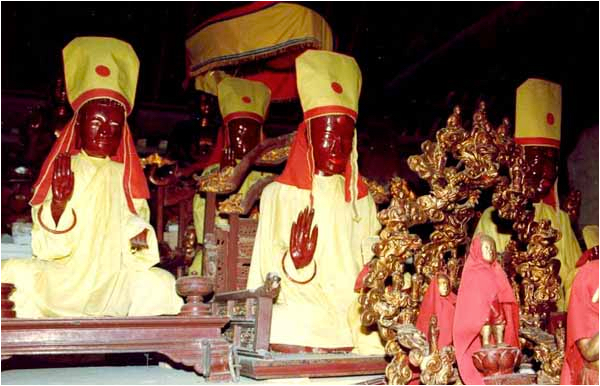
The hậu cung (rear sanctuary) of Mây Temple has three bays, with a simple stacked-beam structure and no carved decorations. The temple preserves 27 statues, most created during the Lê dynasty, two kiệu bát cống (eight-bearer palanquins), and a very precious bronze incense burner. The hậu cung contains statues of General Phạm Phòng Át, his mother, his wife, and his son, who is regarded as a prince. The statues are carved very vividly. During the era of the Twelve Warlords, Phạm Bạch Hổ was considered the King ruling the vast eastern region, including present-day Hải Dương, Hưng Yên, and Hải Phòng. His statue is carved in a majestic posture. The trung từ also contains statues of the four civil and military officials who, together with Phạm Phòng Át, pioneered and built the domain, life-sized, reflecting the peak of 18th-century folk sculpture through the golden hands of local artisans. Mây Temple also preserves large mother-of-pearl inlaid plaques, kiệu bát cống, stone steles, and 23 imperial decrees from the Lê and Nguyễn dynasties. Of the six stone steles, the most valuable is the one inscribed with the "Đặng Châu từ phụng ký" by Hưng Yên Governor Phạm Văn Toán, made in the 11th year (1899) of King Thành Thái's reign. He had fought alongside Marshal Hoàng Kế Viêm against the French at the Battle of Cầu Giấy, killing the enemy general F. Garnier (1873), and was highly valued by the court, appointed as Trung phụng đại phu, Deputy Minister of War, and Deputy Chief Censor of the Censorate. On the occasion of the temple's renovation, he offered a stele inscription praising the merits of Phạm Phòng Át.
Mây Temple Festival
The Mây Temple festival is held annually at two different times: in the first lunar month, from the 8th to the 16th, to commemorate the general's birthday; and from the 12th to the 18th of the 11th lunar month, to commemorate the death anniversary of General Phạm Bạch Hổ. In addition, from the 16th to the 24th of the sixth lunar month is the death anniversary of Phạm Bạch Hổ's mother. Besides the rituals, the festival features many traditional games rich in the culture of the Northern Delta inhabitants, such as wrestling, lion dancing, hát trống quân (antiphonal singing), water puppetry, chess, and more.
Photos
📷 Contribute photosVisiting tips
- Dress modestly; remove hats and keep quiet inside the main hall.
- Incense, flowers and offerings are usually sold right outside the gate; light an odd number of sticks (1 or 3).
- Most pagodas open from early morning to evening and are free to enter (some major sites charge a small scenic fee).
- Full-moon days, the 1st of the lunar month and Tet are very crowded; visit on weekday mornings for a quiet experience.
- Ask permission before photographing inside shrines; do not touch statues or altar objects.
Read more & references
Useful links to learn more before your visit:
Location
Coordinates: 20.67142, 106.04368
🧭 Directions on Google MapsOther pagodas in Hưng Yên