Múa Pagoda
Hưng Yên(formerly Thái Bình)(Chùa Múa)
Overview & history
Múa Pagoda, also known as Phượng Vũ Pagoda, is located in Thọ Lộc hamlet, Minh Khai commune, Vũ Thư district, Thái Bình province. It is an ancient pagoda built at the end of the 17th century during the Nguyễn dynasty. The pagoda is part of the Phượng Vũ temple-pagoda heritage complex. The pagoda is so named because, in the past, when Saint Láng Lý Triều Quốc Sư Từ Đạo Hạnh came to this land to teach the people how to farm, he saw a piece of land shaped like a phoenix spreading its wings to dance. Recognising this auspicious land, he established a pagoda to worship the Buddha. Later, after he attained sainthood, the villagers, grateful to him, established a shrine in his honour.
Architecture
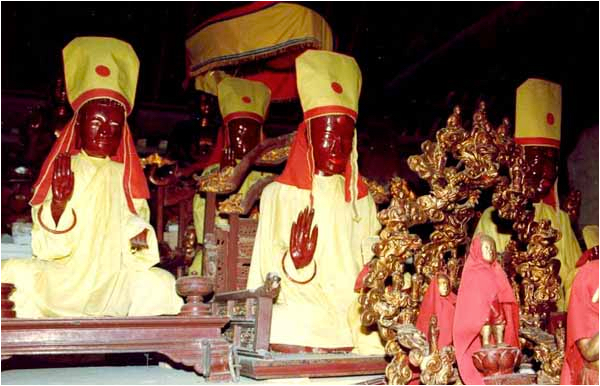
The Buddha Hall of the pagoda is built in the shape of the letter 'đinh' (丁), following the traditional architectural style of Northern Vietnamese Buddhist pagodas, and faces west. The pagoda, constructed at the end of the 17th century, was originally quite small and had deteriorated over time. In 2018, with the support of the Three Jewels, the resident abbot, and the villagers, a major restoration was carried out, resulting in a magnificent and solemn Đại Hùng Bảo Điện (Great Hero Hall) for the Buddha Hall. Inside the Tam Bảo (Triple Gem Hall), the arrangement includes sets of statues such as the Three Times Buddhas, the Amitabha Trinity, and the Lotus Sutra Trinity. In addition, there are statues of Quan Âm Chuẩn Đề (Cundi Avalokiteshvara), Quan Âm Tọa Sơn (Avalokiteshvara Seated on the Mountain), and two very large and imposing Dharma Protectors guarding the Buddha's Dharma. The shrine to Saint Lý Triều Quốc Sư Từ Đạo Hạnh faces south, the direction of prajñā (wisdom), and is built in the shape of the letter 'nhất' (一). Directly behind the shrine is the inner sanctuary, built in the 'đinh' shape, and behind the sanctuary is a three-storey lotus stupa. These three structures are aligned along a north-south spiritual axis. The shrine to Saint Từ Đạo Hạnh represents his three lives: as a monk, as an emperor, and as a deity. Additionally, the temple also worships Tự Đạo Vinh, the father of Đức Thánh Láng. Within the shrine and inner sanctuary, many ritual objects remain, including a very precious black bronze incense burner.
Festival
The festival is held annually from the 7th to the 10th day of the first lunar month. The festival features a ritual of carrying palanquins through the water, with three palanquins: Song Loan, Long Đình, and Kiệu Lễ. According to tradition, on the 26th day of the twelfth lunar month, the young men of the village register with the pagoda to request a place in the palanquin procession. In the spring, on the 6th day of the first lunar month, the pagoda organises an offering ceremony to the saint to select those who will carry the palanquins; only those 'approved' by the saint are allowed to serve. On the previous day (the 8th day of the first lunar month), the village elders and the abbot perform a ceremony so that the palanquin bearers, who are young men from Thọ Lộc village, can carry the palanquins to the Thọ Lộc communal house (đình) and bring ceremonial documents and petitions to the head of the festival committee. On the 9th day, the main festival day, the palanquins are carried from the communal house back to the pagoda. The palanquin procession at Múa Pagoda is very distinctive, especially the ritual of spinning the palanquins and carrying them into the river, even in the cold early spring weather. A local poet, upon witnessing the festival at Múa Pagoda, wrote the following verse:
"Carrying the palanquin on the ninth day of the first month
The palanquin spins, the river sways, earth and sky in motion
Hundreds of thousands of visitors are moved
Visiting Phượng Vũ Pagoda, a memory never forgotten in a lifetime"
Photos
📷 Contribute photosVisiting tips
- Dress modestly; remove hats and keep quiet inside the main hall.
- Incense, flowers and offerings are usually sold right outside the gate; light an odd number of sticks (1 or 3).
- Most pagodas open from early morning to evening and are free to enter (some major sites charge a small scenic fee).
- Full-moon days, the 1st of the lunar month and Tet are very crowded; visit on weekday mornings for a quiet experience.
- Ask permission before photographing inside shrines; do not touch statues or altar objects.
Read more & references
Useful links to learn more before your visit:
References
- Vietnamese Wikipedia
- http://www.thaibinh.gov.vn/ct/introduction/Lists/lhtt/View_Detail.aspx?ItemID=33
- http://news.zing.vn/ruoc-kieu-loi-ao-lanh-suot-5-gio-o-thai-binh-post718367.html
- https://web.archive.org/web/20170205120759/http://news.zing.vn/ruoc-kieu-loi-ao-lanh-suot-5-gio-o-thai-binh-post718367.html
Other pagodas in Hưng Yên