Vietnam Pagodas

Vĩnh Nghiêm Pagoda, Ho Chi Minh City

TP. Hồ Chí Minh(Chùa Vĩnh Nghiêm (Thành phố Hồ Chí Minh))
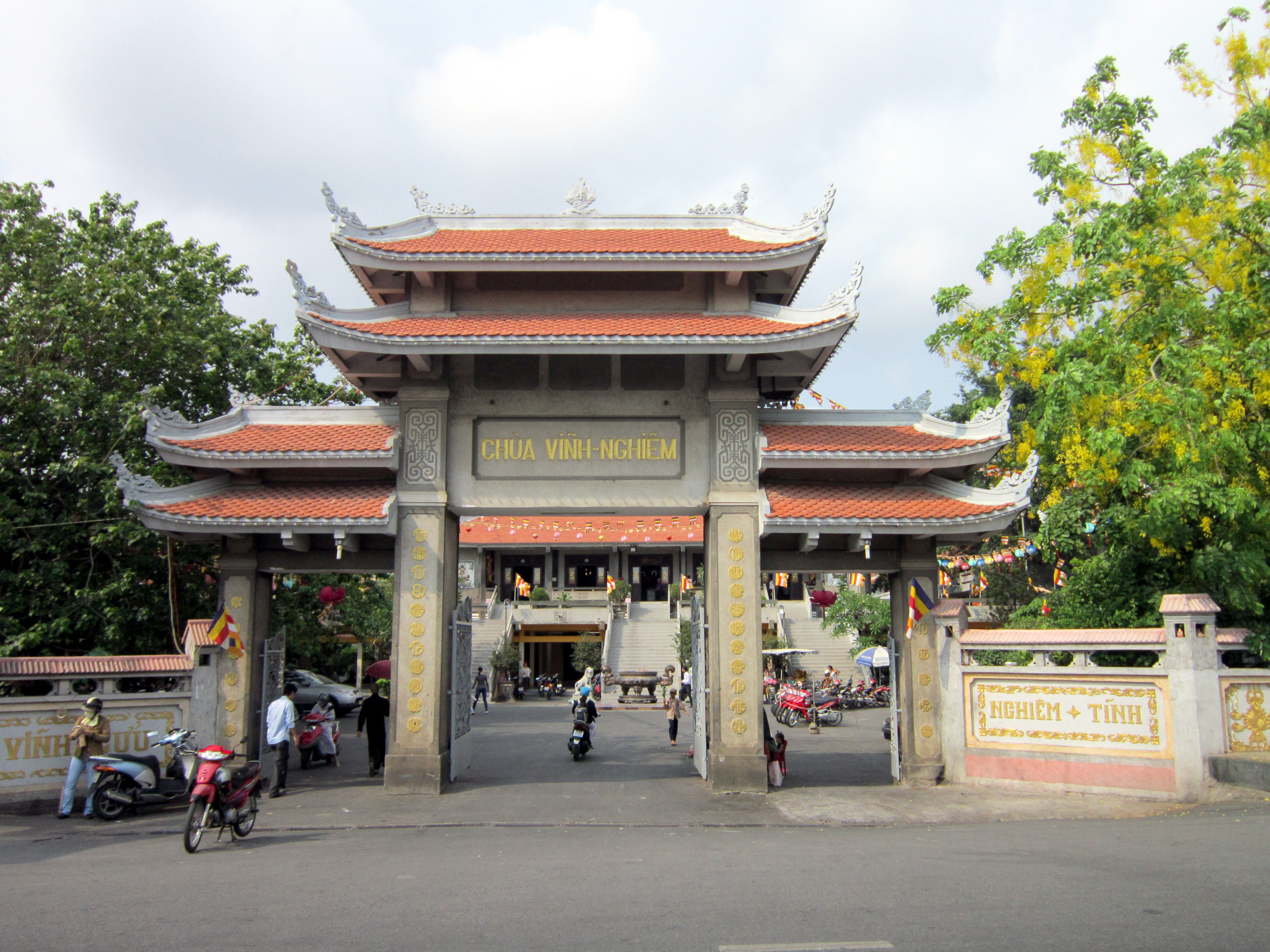
Vĩnh Nghiêm Pagoda, Ho Chi Minh City

Overview & history

Vĩnh Nghiêm Pagoda (Chùa Vĩnh Nghiêm; literally Ever Solemn) is a pagoda in an area of 6,000 square metres (65,000 sq ft) at 339, Nam Kỳ Khởi Nghĩa street, Ward 7, District 3 Ho Chi Minh City. This is the first pagoda in Vietnam to be built in Vietnamese traditional architecture style but with concrete. The highest structure in this pagoda is the 7-story, 40-metre-high (130 ft) tower. This pagoda houses and worship of one buddha and two bodhisattvas: Gautama Buddha, Manjusri, Samantabhadra. The Peace Bell was donated by a monk of Entsuji Temple in Fukushima, Japan. The seven-storey tower was built with the assistance of the Japan-Vietnam Friendship Association.

History

In 1964, two monks, Thích Tâm Giác and Thích Thanh Kiểm, who had come to South Vietnam from North Vietnam to spread Buddhism, began the construction of Vĩnh Nghiêm Pagoda. The model and namesake of the pagoda was the 11th century Vĩnh Nghiêm Pagoda in Đức La Village, Trí Yên Commune, Yên Dũng District, Bắc Giang Province, which dates the reign of Lý Thái Tổ during the Lý dynasty. The village was once a major center of Buddhist teaching and the Trúc Lâm sect of Vietnamese Buddhism.

Visiting tips

  • Dress modestly; remove hats and keep quiet inside the main hall.
  • Incense, flowers and offerings are usually sold right outside the gate; light an odd number of sticks (1 or 3).
  • Most pagodas open from early morning to evening and are free to enter (some major sites charge a small scenic fee).
  • Full-moon days, the 1st of the lunar month and Tet are very crowded; visit on weekday mornings for a quiet experience.
  • Ask permission before photographing inside shrines; do not touch statues or altar objects.

Location

Coordinates: 10.79040, 106.68200

🧭 Directions on Google Maps

Other pagodas in TP. Hồ Chí Minh

🏯
Chùa Đại Tòng Lâm
Đại Tòng Lâm Pagoda, with its full name being Vạn Phật Quang Đại Tòng Lâm Tự, is a grand pagoda featuring many large-scale and modern structures. The pagoda is located on National Highway 51, Quảng Phú quarter, Phú Mỹ ward, Hồ Chí Minh City, Vietnam.
🏯
Chùa Hộ Pháp (Thích Ca Phật Đài)
Hộ Pháp Pagoda is a pagoda built in the Southern (Theravāda) Buddhist architectural style, located at 610/2A Trần Phú, Vũng Tàu Ward, Hồ Chí Minh City, within the Thích Ca Phật Đài architectural complex. The pagoda features four steles inscribed with the Dharmacakrapravartana Sūtra (Discourse on Turning the Wheel of Dharma) in four different languages. The Vietnam Record Organisation has recognised these as holding the record for 'The largest mother-of-pearl inlaid Dharmacakrapravartana Sūtra steles in four languages.'
🏯
Chùa Khỉ
Chùa Khỉ (the official name is Thiền viện Trúc Lâm Chân Nguyên) is located at the foot of Minh Đạm Mountain, in Phước Hải Commune, Hồ Chí Minh City. The pagoda was built in 1990.
🏯
Linh Sơn Cổ Tự
Linh Sơn Cổ Tự Pagoda is a Buddhist temple located at 104 Hoàng Hoa Thám, Vũng Tàu Ward, Ho Chi Minh City, Vietnam. The pagoda was recognised by the Ministry of Culture and Information of Vietnam as a national historical and cultural site on 3 August 1991. The pagoda was originally built in 1919 on Núi Nhỏ (Small Mountain), but as the French occupied the site to build a pilot station, another pagoda was constructed at the current location and has existed until today. This is the oldest pagoda in Vũng Tàu. Although Linh Sơn Cổ Tự Pagoda is not grand or spacious, it is the oldest pagoda in Vũng Tàu, situated on Hoàng Hoa Thám Street, Vũng Tàu Ward. In its early days, the pagoda was built on the slope of Small Mountain, but in 1919 this area was occupied by the French to build villas for their pilots. Immediately afterwards, another pagoda was built and has remained until today. In the main hall, there is a 1.2-metre-high Buddha statue made of stone and gilded with gold leaf, skilfully carved to create a gentle and lively expression on the Buddha’s face, in the style of Chăm Buddha statues. Archaeologists estimate that it dates back about 1,600 years. Regarding the origin of the Buddha statue, legend has it that over a year ago, a group of fishing boats from Central Vietnam came to fish at Bãi Trước. While searching for firewood on Núi Lớn (Big Mountain), they accidentally discovered two stone Buddha statues buried in the ground on the mountainside near Bãi Dâu. They dug them up together and waited until the next day to perform a ritual to take them away. When the local people heard the news, they rushed to see and insisted that these were local historical relics and demanded to keep them. The group of fishermen from Central Vietnam pleaded for a long time before being allowed to take the smaller statue. The larger statue was brought back by the villagers for worship and is the very statue currently enshrined at Linh Sơn Cổ Tự Pagoda.
🏯
Niết Bàn Tịnh Xá
Niết Bàn Tịnh Xá is a Buddhist tịnh xá (monastery/temple) situated on the slope of Núi Nhỏ (Small Mountain), in Vũng Tàu ward, Hồ Chí Minh City, Vietnam. The tịnh xá was organised and constructed by Most Venerable Thích Thiện Huệ from 1969 to 1974 on the slope of Núi Nhỏ, which was formerly known as Tao Phùng Mountain, facing the sea. This is a grand complex consisting of many buildings, covering an area of nearly 10,000 m², and is a famous spiritual tourism and pilgrimage site in Vũng Tàu. On 14 December 1989, the temple was recognised and ranked as a national historical site by the Ministry of Culture and Information of Vietnam.
Thích Ca Phật Đài
Thích Ca Phật Đài
Thích Ca Phật Đài (lit. 'Platform of Shakyamuni Buddha') is a notable Theravada Buddhist temple in the coastal city of Vung Tau in southern Vietnam. It lies to the northwest of the Lớn mountain and was built between 1961 and 1963 when it was opened.