Sóc Lớn Pagoda
Đồng Nai(formerly Bình Phước)(Chùa Sóc Lớn)
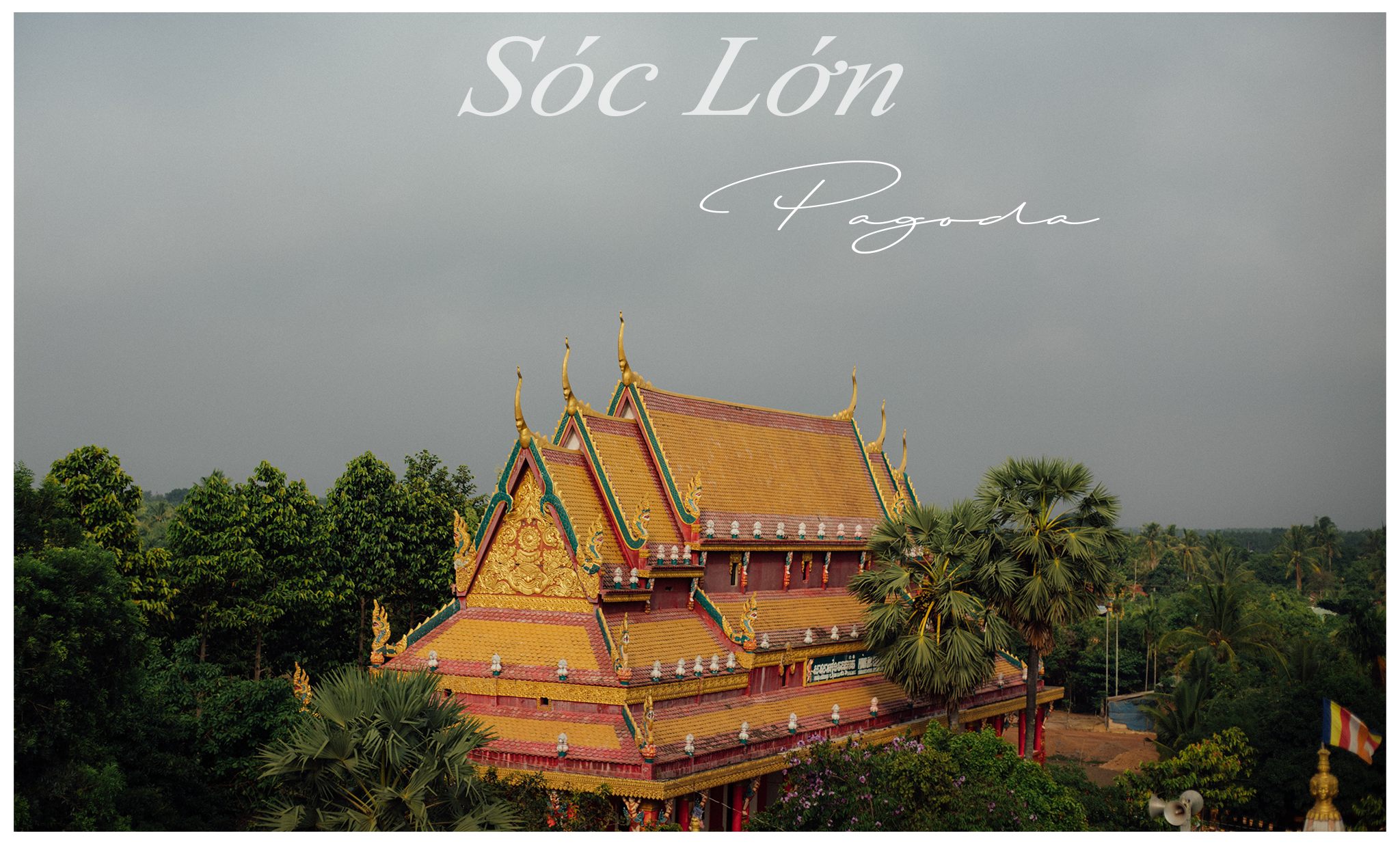
Overview & history
Sóc Lớn Pagoda, in Pali called Rajamahajetavanaram (Khmer: រាជមហាជេតវនារាម), means the pagoda built by the Elder Anāthapiṇḍika and Prince Jeta in the city of Sāvatthī (ancient India) to offer to the Buddha at the Prince Jeta's Grove. The pagoda is also known as Wat Phum Thum according to its Khmer name, where 'phum thum' means 'Sóc Lớn' in Khmer.
Location
Sóc Lớn Pagoda is located in Sóc Lớn hamlet, Lộc Hưng commune, Đồng Nai city.
Brief History of Formation
Upon its establishment, the pagoda was named RajamahaJetavanaram. Rajamahajetavanaram Sóc Lớn Pagoda was initiated by Venerable Tuôch Cháp (originally from Prey Chek district, Svay Rieng province, Cambodia) together with Mr. Lâm Mứt, Lâm Mơm, Lâm Keo, Lâm Duôn and the Buddhist followers in Phum Sóc, who began construction in 1928. The pagoda was completed in 1937, but it was not until 1954 that the Sima Consecration Ceremony was held. The pagoda covers an area of 42,000 m² (forty-two thousand square metres). In addition, the pagoda also has other large plots of land, such as the Sóc Lớn Pagoda Cemetery and Bàu land in Sóc Lớn hamlet, which have been preserved through many generations.
The pagoda was completed and the Sima boundary consecration ceremony was held in 1954 (Buddhist Calendar year 2498), and it was named in Pali as "Rajamahajetavananram Sóc Lớn". Since then, the pagoda has become the cultural, religious, and spiritual centre of the Khmer community in Lộc Khánh commune.
After 1955, Venerable Tuôch Chap built an additional tịnh thất (small monastic residence) in Lộc Hưng. Due to illness and old age, he passed away ten years later (in 1964).
Period of Preservation and Development (1954 - 1973)
From 1955 to 1973, Venerable Mes Khun (from Prey Veng, Cambodia) was invited by the Buddhist followers to serve as abbot. He stayed here to protect and preserve the pagoda until his passing. During the resistance war, the pagoda was a shelter for many revolutionary soldiers.
During this period, the country was in turmoil due to war. At 8pm in 1970, the pagoda was destroyed by three B52 bombs. The entire Main Hall was completely ruined, with only a few Buddha statues remaining. The local people could only build a temporary hut to worship the Buddha statues.
Difficult Period (1973 - 2008)
Due to the war and the destruction of the pagoda, from about 1973 to 1994, although there were no more monks, the Buddhist followers still tried to preserve and protect the pagoda grounds. Under the guidance of Achar Lâm Roi, the lay Buddhists continued to gather, practising their religious faith. In addition, during major festivals, the devotees always tried to invite monks from other pagodas outside the province to conduct ceremonies and perform Buddhist rituals.
By the end of 1994, Venerable Lâm Yêm – Abbot of Pothiwong Pagoda, Ho Chi Minh City – came here to arrange and invite Venerable Lý Sang from Sóc Trăng province to become abbot and continue rebuilding the pagoda. After arriving, Venerable Lý Sang mobilised the Buddhist followers in Phum Srók to build the Sala (prayer hall) for chanting, worshipping the Triple Gem, and monks’ quarters to provide proper accommodation for the monks and facilitate religious and cultural activities for the people. On Sunday, 15 December 2004, Sóc Lớn Pagoda was recognised by the People’s Committee of Bình Phước province as a provincial-level historical and cultural site.
In 2007, due to old age and illness, the Venerable left the management committee and the people to return to his homeland. Afterwards, the Buddhist followers invited Venerable Thạch Sa Thươl – from Ghoshitaram Pagoda, Bạc Liêu – to become abbot. During his time residing here, he did his utmost to protect and preserve the pagoda and led the followers to plant many kinds of trees.
Period of Revival and Continued Development
On 17 May 2009, Sóc Lớn Pagoda entered a new chapter. Venerable Hữu Hinh (Ghoshitaram Pagoda, Bạc Liêu) made careful arrangements to appoint Venerable Thạch Nê (born 04-6-1972, Bạc Liêu) as abbot of the pagoda.
With his responsibilities, he reorganised the pagoda, including the management committee with Mr. Lâm Ben as head, Mr. Lâm Búp and Mr. Lâm Mứt as village elders, and Mr. Lâm Roi as Achar (lay ritual master).
In addition, Buddhist affairs, construction, and education were further developed by Venerable Huỳnh Thanh Chính (Đìa Muồng Pagoda, Bạc Liêu), Venerable Thạch Thương (Kim Cấu Pagoda, Bạc Liêu), and Venerable Thạch Ngọc Hận together with the abbot, expanding the facilities on the previously very wild pagoda grounds as follows:
- The solidly built perimeter gate with exquisite carvings was constructed and completed in 2015;
- On 8 July 2012, he was officially appointed as abbot of Sóc Lớn Pagoda with the endorsement of Venerable Hữu Hinh, the management committee, Buddhist followers, and witnessed by local authorities. The appointment process strictly followed the regulations of the Bình Phước Provincial Buddhist Sangha Administration;
- From 10 October 2010 to 10 January 2015, many works were started and completed, such as electric lamp posts, a Buddha stupa under two bodhi trees and three sugar palm trees, and especially a school for monks and lay Buddhists to have a convenient place to study;
- On 17 July 2013, construction began on a large lecture hall at the rear of the pagoda grounds;
- On 31 December 2015, the foundation stone was laid for the new Main Hall, and at the same time, the surrounding landscape was developed to welcome Buddhists for visits and religious activities at the pagoda.
Regarding education, from 2009 to 2020, 120 monks were ordained and opportunities were created for Khmer children to study at the pagoda as well as at general and university levels. In addition, about 250 novice students have been taken in for study at the pagoda.
Every year, the pagoda organises many classes for monks and Khmer children from Phum Srók to study here, with numbers ranging from 250 to 300 students per year. The classes include Khmer literacy from beginner to grade 4, as well as Buddhist scripture classes for the monks.
On 15 December 2004, Sóc Lớn Pagoda was recognised by the People’s Committee of Bình Phước province as a provincial-level historical and cultural site.
Architecture
Sóc Lớn Pagoda is similar to other Southern Khmer Theravāda Buddhist pagodas. The pagoda is composed of three main elements: landscape, architectural complex, and visual arts (mainly concentrated in the Main Hall).
According to the worldview of Southern Khmer Theravāda Buddhism, the Main Hall (Chánh điện) symbolises Mount Tudi, the abode of the Buddha, while the outside represents the world of deities and sacred creatures. With this concept, Khmer pagodas are always decorated with a system of deity and sacred animal statues from the gate to the Main Hall, arranged in levels from low to high. Each symbol is explained through Buddhist stories or legends, creating a spiritual aura around the pagoda. Sóc Lớn Pagoda was also built according to this concept, always displaying balance in layout and architecture, despite being damaged by war and heavily dependent on the terrain. To enter the pagoda grounds, one must go along a 4-metre-wide road passing through residential households.
Within the pagoda grounds, entering from the gate, on the right is a green park, on the left is a row of single-storey buildings for the monks to study; the ground floor houses a computer room and other Buddhist activity rooms. Opposite the gate is the foundation of the old Main Hall; to the right of the old Main Hall foundation is the new Main Hall currently under construction. To the left of the new Main Hall under construction is the old Lecture Hall (Giảng đường); passing the old Lecture Hall leads to a single-storey building (Tăng xá, monks’ residence), with a meeting room and library on the ground floor and living quarters for the monks on the first floor. Opposite the monks’ study building is the Bodhi Stupa (Tháp Bồ đề). To the right of the Bodhi Stupa is the new Lecture Hall, which also serves as a living space for the monks and a place for devotees to worship, since the Main Hall is under construction, so monastic affairs and major ceremonies are also held here. In the centre of the pagoda grounds is a path of ornamental plants and Buddhist scenes, creating an ancient and solemn beauty of Buddhism.
Sóc Lớn Pagoda is an architectural complex including the gate, Main Hall, Lecture Hall, Bodhi Stupa, etc., built on flat, spacious terrain with the following features:
Pagoda Gate: The gate is cast in cement with a modern architectural style. On the top of the gate is a carving of the Buddha’s birth; the section adjoining the roof is reinforced by Kinnara statues (half-human, half-bird figures), with outstretched arms supporting the eaves. The Kinnara is chosen by the Khmer as a symbol of beauty and strength, with the idea that it will resist nature to shelter and protect people. In addition, the fence surrounding the pagoda grounds is decorated with the story of the monkey Hanuman and the 12 zodiac animals.
Main Hall (Chánh điện): Currently under construction, the old Main Hall was destroyed by war and only the foundation remains. For Southern Khmer Theravāda Buddhism, the Main Hall is one of the most important structures, large in scale, expressing a unique style with traditional Khmer architecture and visual arts.
Lecture Hall (Sala): Consists of two floors, the ground floor and ceremonial hall, and the upper floor is the monks’ guest room. Outside the Sala are Gadura statues (Garuda) supporting the roof columns, symbolising beauty and the united strength of the whole nation. The vertical columns are embossed with celestial patterns—conveying sacredness and the meaning of protection. The horizontal columns are decorated with embossed reliefs of the god Rahu—the wind god who swallows the moon.
Inside the Sala, apart from the altar with the golden statue of Shakyamuni Buddha placed solemnly in the central position, on the right is the altar of the venerable monks who made great contributions to the construction and embellishment of the pagoda. The altars of the late venerable monks are arranged in order from high to low, from left to right. With decorative reliefs rich in Khmer national identity, the Sala gives devotees a sense of solemnity and a light, peaceful spirit when visiting.
Bodhi Stupa (Tháp Bồ đề): Has a small, square base with equal sides. The stupa’s architecture is pyramidal, narrowing as it rises. The stupa has three levels symbolising the Triple Gem (Buddha, Dharma, Sangha) and human liberation. The symbol of Brahma (Phạm Thiên) is modelled after the summit of Mount Sumeru (Xô-me), the abode of this deity.
In addition to the traditional architectural structures required of a Khmer pagoda, Sóc Lớn Pagoda is also decorated with statues of Shakyamuni Buddha meditating under the Bodhi tree, the Buddha bestowing blessings, and various devas, making the pagoda’s landscape more lively and harmonious between architecture and nature.
Throughout its history, the pagoda has been rebuilt to be spacious and dignified under the guidance and responsibility of Venerable Thạch Nê and the deputy abbots, who have reorganised the pagoda, established the Lay Management Committee (Ban hộ tự) and elected Mr. Lâm Ben as head of the committee. In addition, the committee is supervised by Mr. Lâm Búp and Mr. Lâm Mứt (village elders) and Achar Lâm Roi, who together have proposed many directions for Buddhist activities such as construction, education, and charity.
From 2010 to 2015, the abbot, together with the Lay Management Committee and devotees, initiated the construction and development of many works as follows: completion of many electric lamp posts, stupas of the Buddha under two Bodhi trees, and especially a school for monks and Buddhist followers to study and practise Buddhism. In 2013, construction of a large Lecture Hall began, which has now been relatively completed and put into use. In 2015, with the support of Buddhist followers, monks, and the Lay Management Committee, the groundbreaking ceremony for the new Main Hall was held. In addition, monks and devotees have also landscaped the area around the pagoda for visitors and for the spiritual and cultural activities of devotees from near and far when coming to the pagoda.
Organisational Structure
The management structure of the pagoda is called the Monastic Affairs Committee (Ban Tăng sự), consisting of one Head of Monastic Affairs, assisted by one Deputy Head and eight monks in charge of specific areas. The Monastic Affairs Committee is divided into eight areas as follows: Office – Administration, Communications – Technical, Education, Culture, Dharma Propagation, Guidance for Lay Buddhists, Cuisine – Environment, and Charity. The monks in charge of each area report to and are responsible to the Head of Monastic Affairs. In addition, the pagoda has a Lay Management Committee (Ban Hộ tự) to assist with Buddhist affairs. The areas coordinate in planning and implementing Buddhist activities such as organising ceremonies, running summer Khmer language classes, organising Dharma talks, and the monk in charge of Education will plan and compile the curriculum for teaching at the pagoda.
Currently, the abbot of Sóc Lớn Pagoda is Venerable Thạch Nê, who is also the Head of Monastic Affairs at the pagoda. The Venerable and the monks in the pagoda pay great attention to teaching the doctrines, ethics, faith, and the quintessence of Southern Theravāda Buddhism to the monks, novices, and devotees. In addition, they also organise Khmer and Pali language classes to access the scriptures, Vinaya, Abhidhamma, and the essence of Buddhist teachings. The abbot is also responsible for teaching (Pali language, scriptures, Vinaya, and Abhidhamma), taking care of all affairs in the pagoda, and maintaining discipline and monastic practice in the pagoda.
References:
Thạch Nê, Master's Thesis, Southern Khmer Theravāda Buddhism in Bình Phước Today, 2020
Sóc Lớn Pagoda, History of Formation and Development, 2019
Festivals
Sóc Lớn Pagoda is the venue for major festivals of the Khmer people in Bình Phước, including:
Tết Nguyên Đán (Lunar New Year): 4th day of the Lunar New Year
Magha Puja – Buddha’s Decision Festival: 15th day of the 1st lunar month
Chol Chnăm Thmây Festival: 14th–16th April (solar calendar)
Visakha Puja – Buddha’s Birthday Festival: 15th day of the 4th lunar month
Opening ceremony of the summer Khmer language class: 25th May (solar calendar)
Rains Retreat Entry Ceremony: 15th day of the 6th lunar month
Dolta Filial Piety Festival – Khmer Vu Lan: 15th–30th day of the 8th lunar month
Rains Retreat Completion Ceremony: 15th day of the 9th lunar month
Kathina Robe Offering Festival: 20th day of the 9th lunar month
Oóc Om Bóc Moon Worship Festival: 15th day of the 10th lunar month.
Photos
📷 Contribute photosVisiting tips
- Dress modestly; remove hats and keep quiet inside the main hall.
- Incense, flowers and offerings are usually sold right outside the gate; light an odd number of sticks (1 or 3).
- Most pagodas open from early morning to evening and are free to enter (some major sites charge a small scenic fee).
- Full-moon days, the 1st of the lunar month and Tet are very crowded; visit on weekday mornings for a quiet experience.
- Ask permission before photographing inside shrines; do not touch statues or altar objects.
Read more & references
Useful links to learn more before your visit:
References
- Vietnamese Wikipedia
- https://giacngo.vn/PrintView.aspx?Language=vi&ID=32D24A
- https://sunghiephoc.com/phat-giao-nam-tong-khome-viet-nam/
- https://giacngo.vn/PrintView.aspx?Language=vi&ID=726419
- https://binhphuoc.gov.vn/vi/news/Hoat-dong-huyen-thi/di-tich-lich-su-van-hoa-cap-tinh-chua-soc-lon-20463.html
- https://web.archive.org/web/20201130105941/https://giacngo.vn/PrintView.aspx?Language=vi&ID=32D24A